Introduction
ChatGPT has changed how people write, learn, research, and work online. From bloggers and students to business owners and marketers, millions rely on AI to save time and improve productivity.
But here’s something many users don’t realize:
👉 The quality of ChatGPT’s response depends heavily on the quality of your prompt.
If your prompt is weak, your answer will be weak.
If your prompt is clear and detailed, your answer will be powerful.
This is why learning how to write better prompts is one of the most valuable digital skills today.
In this complete guide, you’ll learn:
-
What ChatGPT prompts are
-
Why prompts matter
-
Best ways to write effective prompts
-
Common mistakes to avoid
-
Pro techniques for advanced users
-
Real examples you can copy and adapt
By the end, you’ll know how to talk to ChatGPT in a way that gets smarter, more useful responses every time.
What Is a ChatGPT Prompt?
A prompt is simply the instruction or question you give ChatGPT.
It tells the AI:
-
What you want
-
How you want it
-
Who it’s for
-
Why you need it
Think of a prompt as directions to a driver.
If directions are unclear, the driver may get lost.
The same happens with AI.
Why Writing Better Prompts Matters
Many people try ChatGPT once and feel disappointed. Often, the problem isn’t the AI — it’s the prompt.
Good prompts help you:
✅ Get accurate responses
✅ Save time
✅ Improve content quality
✅ Boost productivity
✅ Reduce editing work
✅ Create SEO-friendly articles
✅ Generate business ideas faster
In short, better prompts = better results.
The Golden Rule of Prompt Writing
Be Clear, Specific, and Detailed
This one rule can transform your results.
Weak Prompt:
Write about marketing.
Better Prompt:
Write a beginner-friendly article explaining digital marketing strategies for small businesses, using simple language and real-life examples.
Notice the difference?
The second prompt gives:
-
Audience
-
Topic focus
-
Tone
-
Style
This guides the AI clearly.
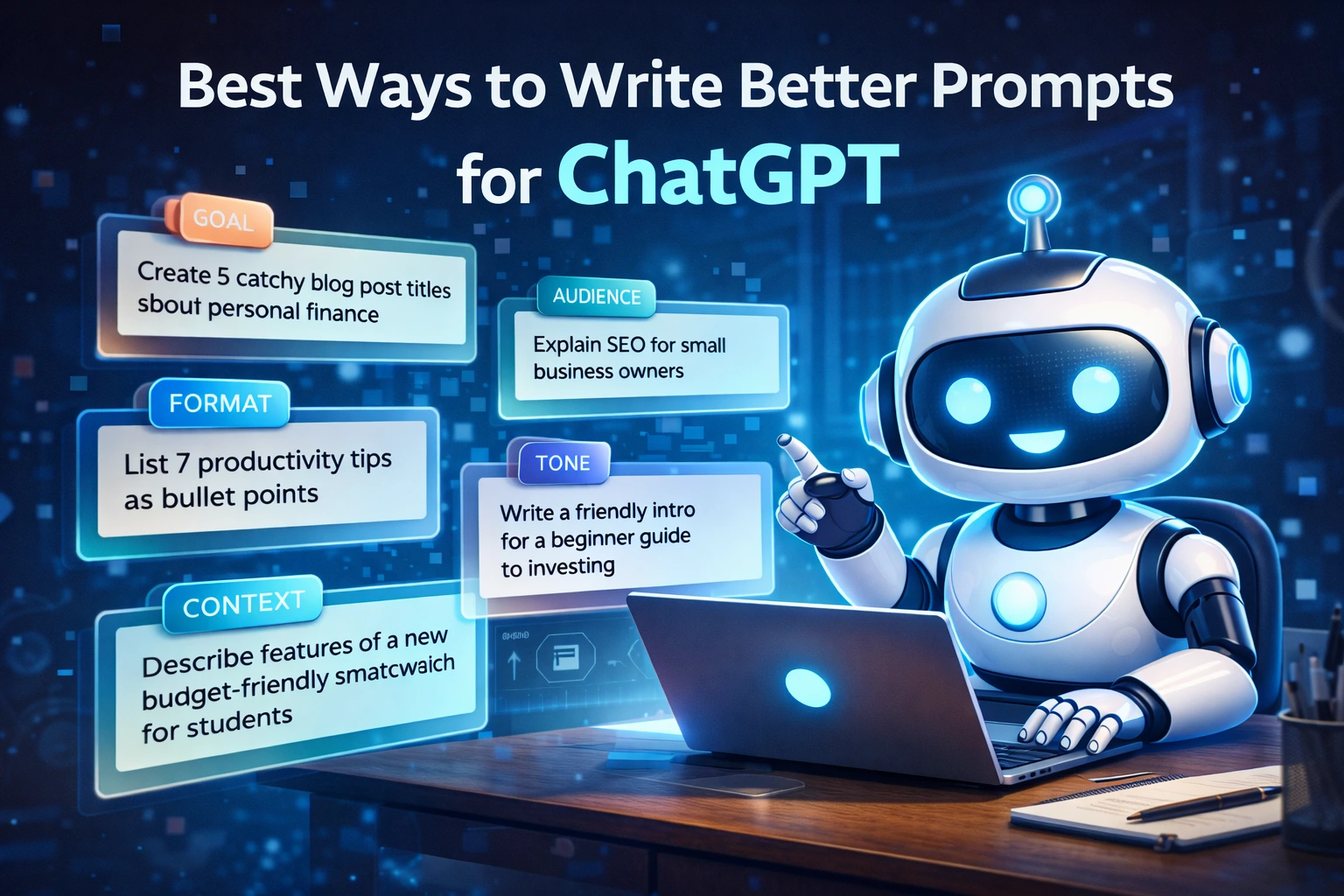
1. Define Your Goal First
Before typing anything, ask yourself:
👉 What do I want to achieve?
Examples:
-
Blog article
-
Social media post
-
Business email
-
Study notes
-
Product description
When your goal is clear, your prompt becomes stronger.
Example:
Instead of:
Tell me about fitness.
Try:
Create a 7-day beginner workout plan for people who want to lose weight at home.
2. Specify the Audience
ChatGPT adjusts its tone depending on who the content is for.
Examples:
-
Beginners
-
Professionals
-
Students
-
Business owners
-
Kids
Prompt Example:
Explain cryptocurrency in simple terms for someone with no finance background.
This ensures the answer matches the reader’s level.
3. Set the Tone and Style
Do you want:
-
Formal?
-
Casual?
-
Friendly?
-
Professional?
-
Persuasive?
Tell the AI.
Example:
Write a friendly blog post introducing time management tips for busy moms.
Tone control makes content feel human.
4. Give Context
Context helps ChatGPT understand your situation.
Example Without Context:
Write a product description.
With Context:
Write a product description for a budget-friendly smartwatch aimed at college students.
Context improves relevance.
5. Mention the Format
Specify structure when needed.
Examples:
-
List
-
Step-by-step guide
-
Table
-
Bullet points
-
Essay
-
Outline
Prompt Example:
Provide 10 bullet-point tips for saving money as a student.
Clear format = clean output.
6. Set a Word Count
If length matters, say it.
Example:
Write a 500-word article on healthy eating habits.
This avoids content that is too short or too long.
7. Ask for Examples
Examples make content stronger.
Example Prompt:
Explain SEO in simple terms and include real-life examples.
This adds clarity and value.
8. Use Step-by-Step Instructions
Breaking prompts into steps improves accuracy.
Example:
First explain what affiliate marketing is. Then give 5 beginner tips. Finally, suggest common mistakes to avoid.
This guides the response logically.
9. Use Role-Based Prompts
Ask ChatGPT to act as a professional.
Examples:
Act as a digital marketing expert and explain social media growth strategies.
Act as a teacher and explain photosynthesis for a 10-year-old.
This improves quality.
10. Refine with Follow-Up Prompts
Great results often come from follow-ups.
Examples:
-
“Make it simpler.”
-
“Add examples.”
-
“Make it more persuasive.”
-
“Rewrite for SEO.”
Prompting is a conversation.
11. Use Constraints
Limitations guide better output.
Examples:
-
Use simple language
-
Avoid jargon
-
Use short sentences
-
Write for Grade 6 reading level
Example:
Explain investing using simple words and short sentences.
12. Request SEO Optimization
For bloggers, this is powerful.
Example Prompt:
Write an SEO-optimized blog post on home workouts including headings and keywords.
AI can structure content for ranking.
13. Ask for Multiple Options
This is great for titles or ideas.
Example:
Give me 10 blog title ideas about personal finance.
You can pick the best.
14. Combine Prompts for Better Results
Layer details.
Example:
Write a 1000-word SEO-friendly article about saving money, for beginners, in a friendly tone, with tips and examples.
More detail = better accuracy.
Common Prompt Writing Mistakes
❌ Being Too Short
Short prompts give generic answers.
❌ Being Too Broad
Wide topics confuse the AI.
❌ No Context
Lack of background reduces relevance.
❌ Expecting Perfection
AI still needs guidance.
Advanced Prompt Techniques
Chain Prompting
Ask step-by-step questions.
Prompt Templates
Reuse formats that work.
Iterative Prompting
Improve results through edits.
Real Examples of Strong Prompts
Blogging
Write a 1200-word SEO article on budgeting tips for young adults.
Business
Create a professional email responding to a customer complaint politely.
Students
Summarize this topic in simple terms for revision.
Social Media
Write 5 Instagram captions for a fitness page.
Benefits of Mastering Prompts
✔ Faster work
✔ Better content
✔ Higher SEO quality
✔ More creativity
✔ Stronger research
✔ Improved productivity
The Future of Prompt Writing
Prompt writing is becoming a digital skill like typing or searching online.
People who master it:
-
Work smarter
-
Save time
-
Earn more online
-
Create better content
Learning prompt writing now is a smart investment.
Conclusion
Writing better prompts is the secret to unlocking ChatGPT’s full power.
Remember:
-
Be specific
-
Add context
-
Define audience
-
Set tone and format
-
Refine responses
ChatGPT is a powerful assistant — but your instructions shape the results.
Master prompting, and you master AI.
FAQs (SEO Boost)
What is a ChatGPT prompt?
A prompt is the instruction or question given to ChatGPT to generate a response.
Why are prompts important?
They guide the AI to produce relevant and accurate answers.
Can prompt writing improve SEO?
Yes. Better prompts create structured, keyword-rich content.
Is prompt writing hard to learn?
No. With practice, anyone can improve.
Check out this 👉🏾 10-chatgpt-ideas-for-online-businesses