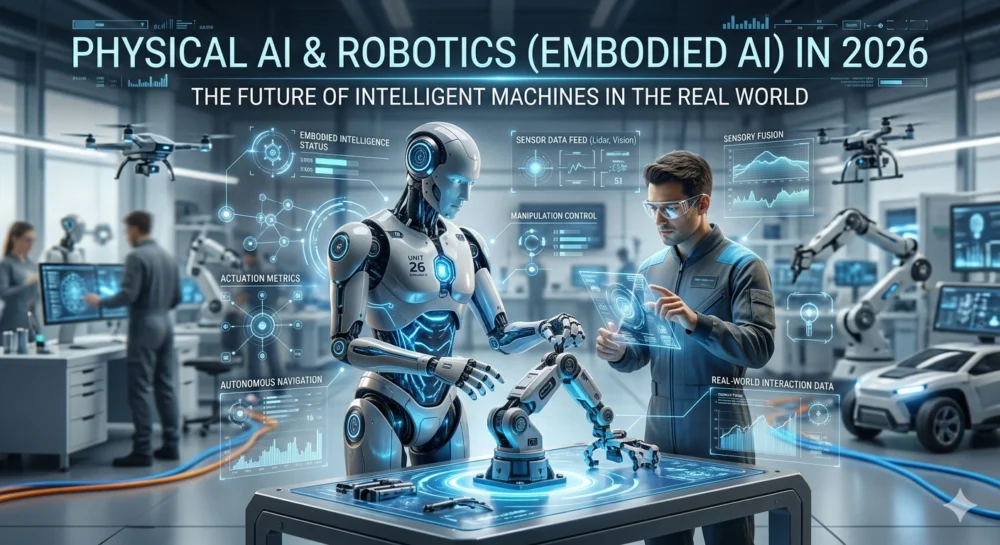
A Complete Beginner’s Tutorial on Embodied AI and Intelligent Machines
Introduction
Artificial Intelligence is no longer limited to chatbots, search engines, recommendation systems, or software that only works on a screen.
A new stage of AI is now growing fast. It is called Physical AI, also known as Embodied AI.
This means AI is no longer only “thinking” inside a computer. It is now being placed inside machines that can see, move, touch, carry, drive, clean, deliver, assist, and interact with the real world.
In simple words:
Physical AI is artificial intelligence with a body.
That body may be a robot, a drone, a self-driving car, a robotic arm, a smart factory machine, a delivery robot, a warehouse robot, a medical robot, or even a future humanoid robot that can work with people.
This is one of the most important technology changes of 2026 because it connects the digital world with the physical world.
Traditional AI can answer questions.
Physical AI can take action.
Traditional AI can recommend a route.
Physical AI can drive the car.
Traditional AI can detect a damaged product from an image.
Physical AI can remove the damaged product from the production line.
Traditional AI can explain how to clean a room.
Physical AI can control a cleaning robot that moves around and cleans the room.
That is why Physical AI matters.
It is not just about machines becoming smarter. It is about machines becoming useful in real environments such as hospitals, factories, roads, farms, homes, airports, warehouses, schools, and offices.
In this full beginner-friendly tutorial, you will learn what Physical AI means, how it works, the components inside it, the different types of physical AI systems, real-life examples, benefits, risks, class work, and the future of robotics.
By the end, even if you are completely new to AI and robotics, you should understand the topic clearly.
Before You Push On, You may want to learn how – Ai Agent Work step-by-step
Table of Contents
- What Is Physical AI?
- What Is Embodied AI?
- Physical AI vs Traditional AI
- Why Physical AI Is Important in 2026
- How Physical AI Works
- Core Components of Physical AI Systems
- Types of Physical AI Systems
- Key Technologies Behind Physical AI
- Real-World Applications of Physical AI
- Case Studies and Practical Examples
- Beginner Class: Understand a Robot Like a Human Body
- Physical AI in Healthcare
- Physical AI in Manufacturing
- Physical AI in Transportation
- Physical AI in Agriculture
- Physical AI in Homes and Offices
- Benefits of Physical AI
- Challenges and Risks
- Ethical Considerations
- Will Physical AI Replace Human Workers?
- The Future of Physical AI
- Class Work and Assignments
- Frequently Asked Questions
- Summary
1. What Is Physical AI?
Physical AI is artificial intelligence that is placed inside a physical machine so that the machine can understand and act in the real world.
A normal AI system may only work with data. For example, a chatbot receives text and gives text back.
But a Physical AI system receives information from the real environment, thinks about what to do, and then takes a physical action.
For example, a warehouse robot may:
- See boxes using cameras.
- Understand the location of each box.
- Decide which box to pick.
- Move its robotic arm.
- Pick up the box.
- Carry it to another place.
- Learn from mistakes and improve next time.
That is Physical AI.
It is not just software. It is software plus hardware plus movement plus learning.
Simple Definition
Physical AI is AI that can sense the real world, make decisions, and take physical action through a machine or robot.
Very Simple Example
Imagine a small robot vacuum cleaner in a room.
It can:
- Move around the room.
- Detect obstacles.
- Avoid chairs and tables.
- Clean dirty areas.
- Return to its charging station.
That is a simple form of Physical AI.
It may not be as advanced as a humanoid robot, but it shows the idea clearly. The AI is not just answering questions. It is controlling a machine in the real world.
2. What Is Embodied AI?
Embodied AI is another name often used for Physical AI.
The word “embodied” means “having a body.”
So, Embodied AI means AI that exists inside a body and interacts with the physical environment.
That body can be:
- A robot body.
- A car.
- A drone.
- A robotic arm.
- A medical machine.
- A smart home device.
- A humanoid robot.
- A factory machine.
The main idea is that the AI is not separated from the real world. It learns by interacting with the environment.
Example of Embodied AI
A chatbot can tell you:
“Move the cup from the table to the shelf.”
But an embodied AI robot can:
- See the cup.
- Locate the shelf.
- Move toward the table.
- Stretch its robotic arm.
- Pick the cup.
- Carry it.
- Place it on the shelf.
This is what makes Embodied AI different.
It connects intelligence with action.
3. Physical AI vs Traditional AI
To understand Physical AI better, let us compare it with traditional AI.
Traditional AI works mostly in digital environments. It handles text, images, numbers, predictions, and recommendations.
Physical AI works in real environments. It controls machines that move, touch, carry, drive, or interact with people.
Comparison Table
| Feature | Traditional AI | Physical AI |
|---|---|---|
| Main Environment | Digital world | Real physical world |
| Input | Text, images, data, clicks | Sensor data, images, sound, touch, distance |
| Output | Prediction, answer, recommendation | Physical action, movement, control |
| Example | Chatbot, search engine, fraud detection | Robot, drone, self-driving car, robotic arm |
| Main Risk | Wrong answer or biased result | Physical damage, injury, safety failure |
| Learning Style | Learns from datasets | Learns from data and real-world interaction |
Simple Explanation
Traditional AI is like a brain inside a computer.
Physical AI is like a brain connected to eyes, ears, hands, legs, and movement.
That is why safety is more serious in Physical AI. If a chatbot gives a wrong answer, it may confuse someone. But if a robot makes a wrong movement, it can damage property or hurt a person.
4. Why Physical AI Is Important in 2026
Physical AI is important because many real-world problems cannot be solved by software alone.
For example:
- A hospital needs help moving patients and assisting doctors.
- A factory needs machines that can inspect products and reduce mistakes.
- A farm needs tools that can monitor crops and improve harvesting.
- A warehouse needs robots that can sort packages faster.
- A city needs smarter traffic systems.
- A home may need robots that can clean, monitor security, or help elderly people.
Software alone cannot do these things.
You need machines that can interact with the real world.
That is where Physical AI comes in.
The Growth of Robotics
Robotics adoption is already growing. The International Federation of Robotics reported that 542,000 industrial robots were installed worldwide in 2024, and annual installations stayed above 500,000 units for the fourth year in a row. This shows that robotics is no longer a future dream. It is already part of modern factories and industries.
Why 2026 Is a Big Year
Physical AI is becoming stronger in 2026 because of improvements in:
- AI models.
- Computer vision.
- Robotics hardware.
- Sensors.
- Edge computing.
- Battery technology.
- Simulation tools.
- Autonomous systems.
- Humanoid robots.
- Smart manufacturing.
Companies like NVIDIA are also investing heavily in Physical AI platforms. In March 2026, NVIDIA announced new Cosmos world models, Isaac simulation frameworks, and Isaac GR00T models to support intelligent robotics and real-world deployment. These tools are designed to help robots understand and act in physical environments.
5. How Physical AI Works
Physical AI works through a continuous loop.
The basic loop is:
Perception → Decision → Action → Feedback → Learning
Let us break that down in simple language.
Step 1: Perception
Perception means the machine collects information from the environment.
It may use:
- Cameras to see.
- Microphones to hear.
- LiDAR to measure distance.
- Touch sensors to feel pressure.
- GPS to know location.
- Temperature sensors to measure heat.
- Motion sensors to detect movement.
This is similar to how humans use eyes, ears, skin, and other senses.
Step 2: Decision
After collecting information, the AI must decide what to do.
For example:
- Should the robot move left or right?
- Should the car stop or continue?
- Should the drone fly higher?
- Should the robotic arm pick the red object or the blue object?
- Should the machine alert a human worker?
This decision is made by AI models, algorithms, and control systems.
Step 3: Action
After deciding, the machine takes action.
Actions may include:
- Moving forward.
- Turning.
- Picking an object.
- Stopping.
- Lifting.
- Sorting.
- Cleaning.
- Driving.
- Flying.
- Speaking.
This action happens through motors, wheels, robotic arms, grippers, propellers, or other mechanical parts.
Step 4: Feedback
After acting, the machine checks what happened.
For example:
- Did it pick the object correctly?
- Did it hit an obstacle?
- Did it reach the destination?
- Did the person respond?
- Did the package fall?
- Did the road condition change?
This feedback helps the system know if the action was successful.
Step 5: Learning
The system can use feedback to improve.
If the robot made a mistake, it can adjust next time. This is how advanced Physical AI systems improve over time.
Concept Flow
Environment
   ↓
Sensors collect data
   ↓
AI processing system understands the data
   ↓
Decision is made
   ↓
Actuators perform action
   ↓
Machine receives feedback
   ↓
System learns and improves
Simple Human Example
Think about a person picking up a glass of water.
- Your eyes see the glass.
- Your brain decides how to move your hand.
- Your hand reaches out.
- Your fingers hold the glass.
- Your brain checks if the glass is stable.
- If it slips, you adjust your grip.
A robot does something similar, but with sensors, processors, motors, and AI models.
6. Core Components of Physical AI Systems
A Physical AI system usually has four major parts.
1. Sensors: The Eyes and Ears
Sensors help machines understand the world.
Without sensors, a robot is blind and unaware.
Examples of Sensors
Cameras
Cameras help robots see objects, people, roads, signs, shelves, products, or obstacles.
LiDAR
LiDAR uses laser light to measure distance. It is useful in self-driving cars, drones, mapping, and navigation.
Microphones
Microphones allow machines to hear voice commands, alarms, or environmental sounds.
Touch Sensors
Touch sensors help robots feel pressure. This is important when holding delicate objects.
GPS
GPS helps vehicles, drones, and delivery robots understand their location.
Temperature Sensors
These help machines detect heat, cold, fire, or environmental conditions.
2. Processing Unit: The Brain
The processing unit is where the AI makes decisions.
It may include:
- CPUs.
- GPUs.
- AI chips.
- Edge devices.
- Neural networks.
- Machine learning models.
In simple language, this is the robot’s brain.
It receives sensor information, processes it, and decides what action to take.
3. Actuators: The Muscles
Actuators are the parts that create movement.
They allow robots to act.
Examples of Actuators
- Motors.
- Wheels.
- Robotic arms.
- Grippers.
- Hydraulic systems.
- Propellers.
- Servo motors.
If sensors are the eyes and ears, actuators are the hands and legs.
4. Learning System: The Experience Builder
The learning system helps the machine improve.
It may use:
- Reinforcement learning.
- Imitation learning.
- Simulation training.
- Human feedback.
- Real-world data.
This is what allows a robot to become better at tasks over time.
7. Types of Physical AI Systems
Physical AI appears in many forms.
1. Autonomous Robots
Autonomous robots can perform tasks with little or no human control.
Examples:
- Warehouse robots.
- Factory robots.
- Delivery robots.
- Security robots.
- Inspection robots.
2. Humanoid Robots
Humanoid robots are designed to look or move like humans.
They may have:
- A head.
- Arms.
- Hands.
- Legs.
- Face-like features.
- Voice interaction.
Humanoid robots are useful in research, customer service, elder care, and future workplace assistance.
However, humanoid robots are still difficult to build because human movement is complex.
3. Self-Driving Vehicles
Self-driving vehicles use AI to understand roads and make driving decisions.
They may use:
- Cameras.
- Radar.
- LiDAR.
- GPS.
- Maps.
- AI prediction systems.
Examples include autonomous cars, buses, trucks, and delivery vehicles.
4. Drones
Drones are flying robots.
They can be used for:
- Delivery.
- Farming.
- Security.
- Mapping.
- Disaster response.
- Filming.
- Infrastructure inspection.
5. Service Robots
Service robots help people directly.
Examples:
- Cleaning robots.
- Hotel delivery robots.
- Restaurant robots.
- Hospital assistant robots.
- Customer service robots.
6. Collaborative Robots
Collaborative robots are also called cobots.
They are designed to work safely beside humans, especially in factories.
A cobot may help with:
- Lifting.
- Assembling.
- Packaging.
- Sorting.
- Welding.
- Inspection.
8. Key Technologies Behind Physical AI
Physical AI is not one technology. It is a combination of many technologies working together.
1. Computer Vision
Computer vision allows machines to understand images and videos.
It helps a robot answer questions like:
- What object is in front of me?
- Is this a person or a box?
- Where is the road lane?
- Is this product damaged?
- Is there an obstacle nearby?
Computer vision is one of the most important technologies in Physical AI.
2. Reinforcement Learning
Reinforcement learning is a method where an AI learns by trial and error.
For example, a robot may try to pick up an object many times. When it succeeds, it receives a reward. When it fails, it learns what not to do.
This is similar to how a child learns by trying, failing, and improving.
3. Robotics Engineering
Robotics engineering deals with building the physical machine.
It includes:
- Mechanical design.
- Motors.
- Arms.
- Wheels.
- Joints.
- Balance.
- Power systems.
- Materials.
Without good robotics engineering, the AI may be smart but the machine will not move properly.
4. Edge Computing
Edge computing means processing data close to where it is collected.
This is important because Physical AI often needs fast decisions.
For example, a self-driving car cannot wait for a distant server before deciding to brake. It must process information quickly on the vehicle.
5. Internet of Things
The Internet of Things, or IoT, connects devices together.
In Physical AI, IoT can allow robots, sensors, machines, and control systems to share information.
For example, in a smart factory, robots and machines can communicate to coordinate production.
6. Simulation
Simulation allows robots to train in virtual environments before entering the real world.
This is very useful because training robots only in the real world can be expensive, slow, and dangerous.
In simulation, a robot can practice thousands or millions of times without breaking real equipment.
9. Real-World Applications of Physical AI
Physical AI is already being used in many industries.
1. Healthcare
In healthcare, Physical AI can support doctors, nurses, patients, and hospitals.
Examples:
- Robotically assisted surgery.
- Rehabilitation robots.
- Patient lifting robots.
- Hospital delivery robots.
- AI-powered prosthetics.
- Elderly care robots.
- Disinfection robots.
The FDA explains that robotically assisted surgery can be safe and effective for certain procedures when used properly and with proper training. This is important because robotic healthcare systems must be handled carefully.
2. Manufacturing
Manufacturing is one of the strongest areas for robotics.
Physical AI can help with:
- Assembly.
- Welding.
- Painting.
- Sorting.
- Packaging.
- Quality inspection.
- Predictive maintenance.
- Worker safety.
A smart factory can use Physical AI to reduce errors and increase production speed.
3. Transportation
Physical AI is used in:
- Self-driving cars.
- Smart traffic lights.
- Autonomous buses.
- Delivery robots.
- Autonomous trucks.
- Drones.
These systems can help reduce human workload and improve transport efficiency. But safety remains a major concern.
4. Agriculture
Physical AI can help farmers produce more food with better efficiency.
Examples:
- Crop monitoring drones.
- Soil analysis robots.
- Automated harvesters.
- Smart irrigation systems.
- Weed detection robots.
- Livestock monitoring.
This can help farmers save time, reduce waste, and improve crop yields.
5. Home Automation
Many people already use simple Physical AI at home.
Examples:
- Robot vacuum cleaners.
- Smart security cameras.
- Smart door locks.
- AI-powered appliances.
- Home assistant devices.
- Lawn mowing robots.
These tools make home tasks easier and more automatic.
6. Logistics and Warehousing
Warehouses use Physical AI to move goods faster.
Examples:
- Package sorting robots.
- Inventory scanning robots.
- Autonomous mobile robots.
- Delivery route optimization.
- Robotic picking systems.
This is very useful for e-commerce, shipping companies, supermarkets, and large storage facilities.
10. Case Studies and Practical Examples
Case Study 1: Warehouse Robotics
Imagine a warehouse with thousands of products.
A human worker may spend a lot of time walking from one shelf to another.
A warehouse robot can help by:
- Reading product location.
- Moving to the correct shelf.
- Avoiding people and obstacles.
- Carrying items.
- Delivering them to packing stations.
Result
This can lead to:
- Faster order processing.
- Lower human stress.
- Better inventory control.
- Fewer picking mistakes.
- Improved delivery speed.
Beginner Explanation
The robot is not “magic.” It works because it has sensors, maps, software, motors, and AI planning.
Case Study 2: Autonomous Vehicles
A self-driving vehicle must understand the road in real time.
It needs to detect:
- Other cars.
- Pedestrians.
- Cyclists.
- Traffic lights.
- Road signs.
- Road lanes.
- Weather conditions.
- Sudden obstacles.
The vehicle must then decide:
- Should I stop?
- Should I slow down?
- Should I change lane?
- Is it safe to turn?
- Is there a person crossing?
Safety Note
People often say human error causes over 90% of accidents. A more careful statement is that NHTSA assigned the “critical reason” to the driver in about 94% of studied crashes, but NHTSA also warned that this should not be interpreted as the full cause of the crash or as legal fault.
That means autonomous vehicles may help improve safety, but they must be tested and regulated carefully.
Case Study 3: Healthcare Robotics
In hospitals, robotic systems can assist doctors during certain procedures.
For example, a robotically assisted surgical system may help a surgeon make more precise movements.
However, it is important to understand that these systems are usually not fully independent. They are tools used by trained medical professionals.
Result
Possible benefits include:
- Better precision.
- Smaller cuts in some procedures.
- Less invasive surgery.
- Faster recovery in some cases.
- Better control for trained surgeons.
Important Warning
Medical robots must be approved, properly maintained, and used by trained professionals. In healthcare, safety is more important than speed.
11. Beginner Class: Understand a Robot Like a Human Body
This class activity will help beginners understand Physical AI easily.
Class Title
Understanding Physical AI Using the Human Body Example
Class Objective
By the end of this class, you should be able to explain the main parts of a Physical AI system using simple human body comparisons.
Lesson Table
| Human Body Part | Robot Equivalent | Function |
|---|---|---|
| Eyes | Cameras | Seeing objects |
| Ears | Microphones | Hearing sounds |
| Skin | Touch sensors | Feeling pressure |
| Brain | AI processor | Making decisions |
| Muscles | Actuators | Creating movement |
| Hands | Robotic grippers | Holding objects |
| Legs | Wheels or robot legs | Moving around |
| Memory | Data storage | Remembering information |
Class Exercise
Look at a robot vacuum cleaner and answer these questions:
- What sensors does it use?
- How does it know where to move?
- How does it avoid obstacles?
- What action does it take?
- How does it return to its charging station?
Expected Answer
A robot vacuum uses sensors to detect walls, furniture, dirt, and floor space. Its processor decides where to move. Its wheels move it around. It uses feedback to know where it has cleaned and when to return to charge.
12. Physical AI in Healthcare
Healthcare is one of the most sensitive and important areas for Physical AI.
Examples
Robotic Surgery
Robotic surgery systems help surgeons perform certain procedures with better control.
They may provide:
- Improved viewing.
- Smaller instruments.
- More precise movement.
- Reduced hand tremor.
- Better access to difficult areas.
But the human surgeon remains responsible for controlling the process.
Rehabilitation Robots
These robots help patients recover movement after injury, stroke, or surgery.
They may assist with:
- Walking practice.
- Arm movement.
- Muscle training.
- Repetitive therapy.
Patient Care Robots
Patient care robots may help with:
- Delivering medicine.
- Carrying hospital materials.
- Assisting elderly people.
- Monitoring patient movement.
- Reducing nurse workload.
Benefits in Healthcare
- Better precision.
- Less physical stress on health workers.
- Improved patient support.
- Faster hospital logistics.
- More consistent rehabilitation practice.
Challenges in Healthcare
- High cost.
- Training requirements.
- Safety concerns.
- Maintenance.
- Patient trust.
- Legal responsibility.
13. Physical AI in Manufacturing
Manufacturing is where robots have already made a huge impact.
Factories use robots because many tasks are repetitive, heavy, dangerous, or require high precision.
Common Factory Uses
- Car assembly.
- Electronics assembly.
- Metal welding.
- Product sorting.
- Packaging.
- Painting.
- Quality checking.
- Machine monitoring.
Why Factories Use Physical AI
Factories need speed, accuracy, and consistency.
A robot does not get tired like a human. It can repeat the same movement many times with high precision.
But humans are still needed for:
- Planning.
- Supervision.
- Maintenance.
- Quality control.
- Safety management.
- Complex decision-making.
Example
A factory may use a camera-powered robot to inspect products moving on a conveyor belt.
If the AI detects a damaged product, the robotic arm removes it automatically.
This reduces waste and improves quality.
14. Physical AI in Transportation
Transportation is one of the most discussed areas of Physical AI.
Examples
- Self-driving cars.
- Autonomous buses.
- Smart trains.
- Delivery drones.
- Autonomous trucks.
- Traffic monitoring systems.
How a Self-Driving Car Works
A self-driving car uses sensors to understand its environment.
It may use:
- Cameras.
- Radar.
- LiDAR.
- GPS.
- Maps.
- AI prediction models.
The system must understand:
- Where the road is.
- Where other vehicles are.
- Whether pedestrians are crossing.
- Whether the traffic light is red or green.
- Whether the road is wet.
- Whether another driver may suddenly stop.
Why This Is Difficult
Driving is not only about moving a car.
It requires understanding human behavior, weather, road conditions, local rules, and unexpected events.
That is why full self-driving is difficult.
15. Physical AI in Agriculture
Agriculture is another area where Physical AI can help.
Farmers face problems such as:
- Labor shortage.
- Climate changes.
- Pest attacks.
- Water waste.
- Crop disease.
- Poor soil information.
Physical AI can support farmers with better monitoring and automation.
Examples
Crop Monitoring Drones
Drones can fly over farms and capture images.
AI can analyze those images to detect:
- Crop disease.
- Dry areas.
- Pest damage.
- Growth levels.
- Irrigation problems.
Automated Harvesting
Some robots can help harvest fruits or vegetables.
This is difficult because crops are delicate. The robot must know how much force to use.
Smart Irrigation
AI-powered systems can decide when and where to water crops.
This can save water and improve yield.
16. Physical AI in Homes and Offices
Physical AI is not only for big industries. It is also entering homes and offices.
Home Examples
- Robot vacuum cleaners.
- Smart security cameras.
- Voice-controlled devices.
- Smart lighting.
- AI-powered appliances.
- Elderly care robots.
Office Examples
- Delivery robots.
- Cleaning robots.
- Security patrol robots.
- Smart access systems.
- Meeting room automation.
Simple Example
A smart security camera can detect movement and identify whether it is a person, animal, or vehicle.
A more advanced physical system can then trigger an alarm, lock a door, or send a notification.
17. Benefits of Physical AI
Physical AI has many benefits.
1. Efficiency
Robots can perform repetitive tasks faster and longer.
2. Precision
Robots can make very accurate movements, especially in manufacturing and surgery.
3. Safety
Robots can work in dangerous places such as mines, disaster zones, chemical plants, or high-temperature environments.
4. Cost Reduction Over Time
Although robots can be expensive at first, they may reduce long-term operating costs in some industries.
5. Continuous Learning
Advanced systems can improve by learning from real-world feedback.
6. Better Productivity
Physical AI can help businesses produce more, deliver faster, and reduce delays.
7. Support for Humans
Robots can assist humans instead of replacing them completely.
For example, a robot may lift heavy objects while a human worker supervises.
18. Challenges and Risks
Physical AI also has serious challenges.
1. High Cost
Robots can be expensive to buy, install, maintain, and repair.
2. Safety Concerns
A robot that moves in the real world can cause harm if it malfunctions.
3. Technical Complexity
Physical AI combines many difficult fields:
- AI.
- Mechanical engineering.
- Electrical engineering.
- Software development.
- Safety engineering.
- Human behavior.
4. Data Dependency
AI needs data to learn. Poor data can lead to poor decisions.
5. Job Displacement
Some repetitive jobs may reduce as automation grows.
6. Regulation Problems
Many governments are still creating rules for autonomous machines.
7. Cybersecurity Risks
If a robot or autonomous system is hacked, the damage can be serious.
19. Ethical Considerations
Physical AI raises important ethical questions.
Who Is Responsible When a Robot Makes a Mistake?
Is it:
- The manufacturer?
- The software developer?
- The owner?
- The operator?
- The AI model provider?
This is a difficult legal question.
How Do We Protect Jobs?
Automation can improve productivity, but it can also affect workers.
Society must think about:
- Retraining workers.
- Creating new jobs.
- Supporting affected communities.
- Teaching digital and technical skills.
How Do We Avoid Bias?
AI systems can make unfair decisions if trained on poor or biased data.
For example, a security robot must not treat people unfairly based on appearance, clothing, language, or location.
How Do We Keep Humans in Control?
For high-risk systems, humans should remain involved.
Examples:
- Medical robots.
- Military robots.
- Autonomous vehicles.
- Industrial machines near workers.
20. Will Physical AI Replace Human Workers?
Physical AI will replace some tasks, but not all human work.
The better way to understand it is this:
Robots replace repetitive tasks faster than they replace human judgment.
Jobs that involve predictable, repeated physical actions are more likely to be automated.
Examples:
- Sorting packages.
- Moving items in warehouses.
- Repetitive factory assembly.
- Basic cleaning.
- Simple inspection.
But many jobs still need humans.
Humans are needed for:
- Creativity.
- Leadership.
- Emotional care.
- Complex judgment.
- Customer relationship.
- Strategy.
- Maintenance.
- Supervision.
- Ethics.
- Problem-solving.
New Jobs Physical AI May Create
Physical AI may create jobs such as:
- Robot technician.
- AI safety officer.
- Automation trainer.
- Robotics maintenance engineer.
- Robot operations manager.
- AI ethics specialist.
- Simulation designer.
- Human-robot interaction designer.
So the future is not only job loss. It is job change.
21. The Future of Physical AI
The future of Physical AI is very exciting.
Trend 1: Human-Robot Collaboration
More robots will work beside humans instead of replacing them completely.
This is already happening in factories with cobots.
Trend 2: Smarter Humanoid Robots
Humanoid robots may become more capable, especially in environments designed for humans.
For example:
- Offices.
- Hospitals.
- Warehouses.
- Homes.
- Hotels.
Trend 3: Better Simulation Training
Robots will train in virtual worlds before entering real environments.
This can reduce cost and improve safety.
Trend 4: Physical AI in Africa
Physical AI can help African countries in areas such as:
- Agriculture.
- Healthcare.
- Security.
- Logistics.
- Education.
- Smart city development.
For example, AI-powered drones can help farmers monitor large farms more easily. Smart medical robots can support hospitals with limited staff. Warehouse robots can improve supply chains.
Trend 5: Personal Robots
In the future, more homes may have personal robots for:
- Cleaning.
- Elder care.
- Home monitoring.
- Simple assistance.
- Education.
- Companionship.
Future Timeline
2020 → Early adoption of smart robotics
2025 → Rapid expansion of AI-powered machines
2026 → Stronger Physical AI platforms and robotics growth
2030 → Wider industrial and home adoption
2040 → More natural human-robot collaboration
22. Class Work and Assignments
This section makes the article useful for students and beginners.
Class Work 1: Identify Physical AI Around You
Write down five machines around you that may use Physical AI or automation.
Examples:
- Robot vacuum.
- Smart camera.
- ATM.
- Drone.
- Smart car feature.
- Factory machine.
- Security scanner.
For each one, answer:
- What does it sense?
- What decision does it make?
- What action does it take?
- Is it fully automatic or partly controlled by humans?
Class Work 2: Draw the Physical AI Loop
Draw this flow:
Sensor → AI Brain → Decision → Movement → Feedback → Learning
Then explain each part in your own words.
Class Work 3: Compare AI and Physical AI
Fill this table:
| Question | Traditional AI | Physical AI |
|---|---|---|
| Does it move? | ||
| Does it use sensors? | ||
| Can it act in the real world? | ||
| Example |
Class Work 4: Design Your Own Robot
Imagine you want to build a robot for your community.
Answer:
- What problem will it solve?
- Where will it work?
- What sensors will it need?
- What actions will it perform?
- What safety rules should it follow?
Example Answer
I want to design a farm robot that checks crops.
It will use cameras to detect crop disease, wheels to move around, solar power to charge, and AI to identify unhealthy plants. It should stop when it detects a person nearby.
Assignment
Write a short essay on this topic:
“How Physical AI Can Improve Agriculture, Healthcare, or Transportation in Africa.”
Minimum length: 500 words.
23. Frequently Asked Questions
1. What is Physical AI?
Physical AI is artificial intelligence placed inside a physical machine so it can sense, decide, move, and act in the real world.
2. What is Embodied AI?
Embodied AI means AI that has a body. It can interact with the physical environment through sensors and movement.
3. Is Physical AI the same as robotics?
Not exactly.
Robotics is the machine body. AI is the intelligence. Physical AI combines both.
4. What is a simple example of Physical AI?
A robot vacuum cleaner is a simple example. It senses the room, avoids obstacles, moves around, and cleans the floor.
5. Are self-driving cars Physical AI?
Yes. Self-driving cars are examples of Physical AI because they sense roads, make decisions, and control physical movement.
6. Are humanoid robots already common?
No. Humanoid robots are improving, but they are not yet common in everyday homes. Many are still in research, testing, or early business use.
7. Can Physical AI learn on its own?
Some systems can improve through machine learning, feedback, and reinforcement learning. But they still need human design, supervision, and safety controls.
8. Is Physical AI safe?
It can be safe when properly designed, tested, regulated, and monitored. But because it acts in the real world, safety must be taken seriously.
9. Will robots replace human workers?
Robots may replace some repetitive tasks, but they will also create new jobs in maintenance, supervision, robotics operation, AI safety, and technical support.
10. Which industries use Physical AI the most?
The major industries include manufacturing, healthcare, transportation, logistics, agriculture, and home automation.
11. What skills are needed to work in Physical AI?
Useful skills include:
- Basic programming.
- AI and machine learning.
- Robotics.
- Electronics.
- Mechanical design.
- Computer vision.
- Data analysis.
- Safety engineering.
12. Can beginners learn Physical AI?
Yes. Beginners can start by learning simple robotics, Python, Arduino, Raspberry Pi, sensors, and basic AI concepts.
13. What is the difference between a robot and an AI robot?
A normal robot may only follow fixed instructions. An AI robot can understand data, make decisions, and adapt to situations.
14. Why is simulation important in Physical AI?
Simulation allows robots to train safely in a virtual world before they work in real life.
15. What is the future of Physical AI?
The future includes smarter robots, better autonomous vehicles, human-robot collaboration, smart factories, AI-powered farms, and personal robots.
24. Summary
Physical AI, also known as Embodied AI, is one of the biggest technology trends in 2026.
It means artificial intelligence is no longer limited to screens, apps, and websites. It is now entering machines that can move, sense, interact, and act in the real world.
Physical AI combines:
- Sensors.
- AI models.
- Processing units.
- Actuators.
- Learning systems.
- Robotics engineering.
- Real-world feedback.
It is already transforming industries such as healthcare, manufacturing, transportation, agriculture, logistics, and home automation.
However, it also comes with challenges. These include high cost, safety risks, job displacement, cybersecurity concerns, and ethical questions.
The most important thing to understand is this:
Physical AI is not just about robots replacing people. It is about machines becoming smarter helpers in the real world.
For beginners, the best way to understand Physical AI is to think of it like a human body:
- Sensors are the eyes and ears.
- The processor is the brain.
- Actuators are the muscles.
- Feedback is experience.
- Learning is improvement.
As AI continues to grow, Physical AI will become a major part of everyday life. From smart homes to farms, hospitals, roads, and factories, intelligent machines will keep shaping the future.