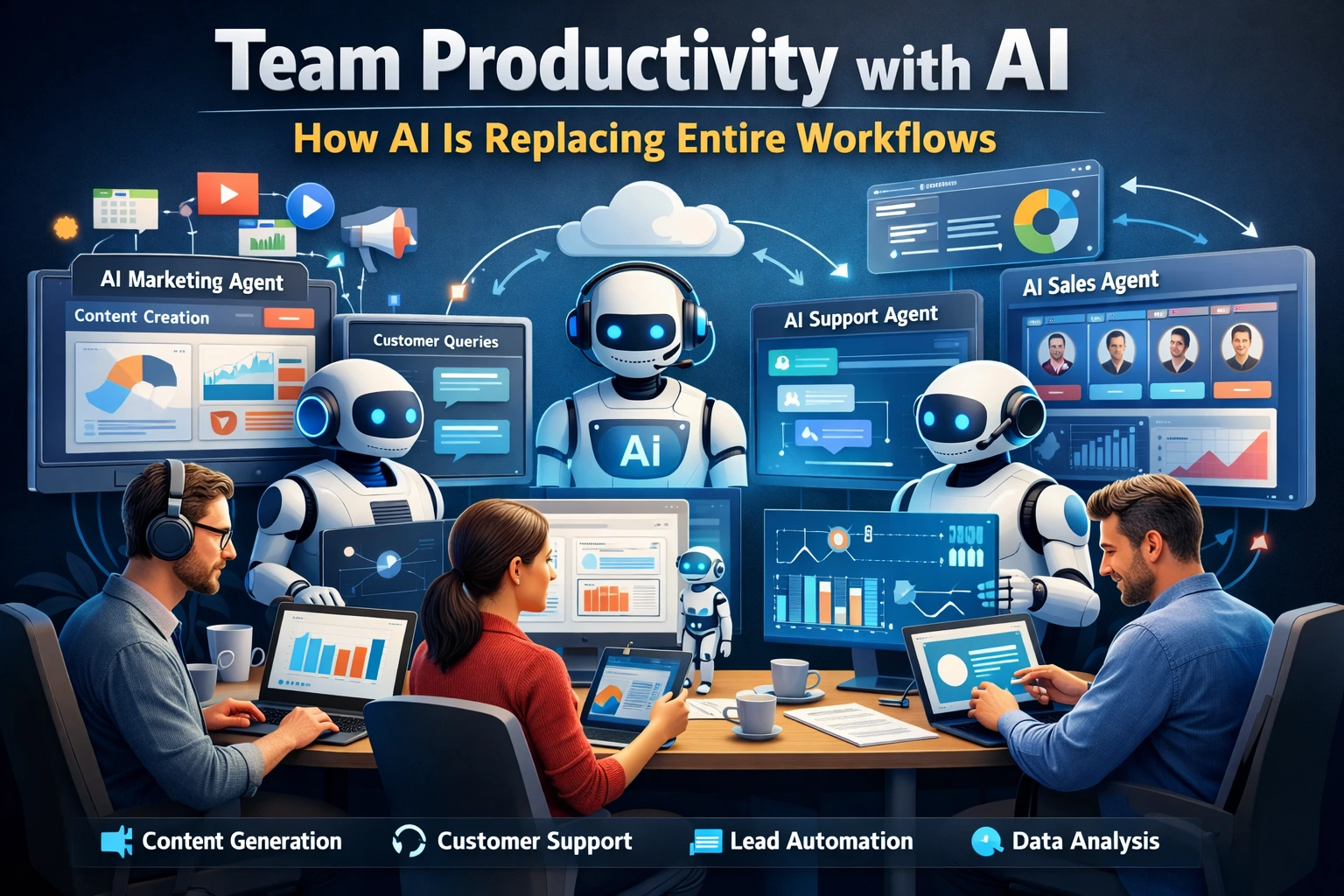
How AI Is Replacing Entire Workflows
Artificial Intelligence is no longer just a support tool. It is becoming a decision-maker, executor, and workflow manager. Across startups, agencies, and enterprise teams, AI is not just automating tasks — it is replacing entire workflows.
Welcome to the era of Agentic Workflows.
In this in-depth guide, you’ll learn:
-
What agentic workflows really mean
-
How AI is replacing traditional team processes
-
Practical use cases across departments
-
Tools enabling full workflow automation
-
Benefits, risks, and strategic adoption steps
-
How to implement AI into your team without chaos
If you run a digital business, content agency, startup, or remote team, this may be the most important productivity shift you’ll ever implement.
What Are Agentic Workflows?
An agentic workflow is a system where AI acts as an independent “agent” that can:
-
Understand objectives
-
Break them into tasks
-
Execute those tasks
-
Make decisions
-
Adapt based on feedback
-
Communicate results
Unlike simple automation (which follows rigid rules), agentic AI can reason, adjust, and operate across multiple tools.
For example:
Traditional Workflow:
-
Manager assigns task
-
Researcher gathers data
-
Writer drafts content
-
Editor reviews
-
Designer creates visuals
-
Publisher uploads
Agentic Workflow:
-
AI receives content goal
-
AI researches, writes, edits
-
AI generates images
-
AI schedules publishing
-
AI analyzes performance
-
AI optimizes next post
Minimal human intervention.
This is not science fiction. Tools inspired by advancements from companies like OpenAI, Google, and Microsoft are already enabling this shift.
Why AI Is Replacing Entire Workflows
AI replaces workflows for three main reasons:
1. Speed
AI executes tasks in seconds that would take teams hours.
2. Consistency
No fatigue. No emotional burnout. No productivity dips.
3. Integration Power
Modern AI integrates across:
-
Email
-
CRM
-
Project management tools
-
Social media platforms
-
Analytics dashboards
-
Cloud storage
Instead of humans switching between tools, AI operates inside all of them simultaneously.
The Shift: From Task Automation to Workflow Replacement
There are three levels of AI integration:
Level 1: Task Assistance
-
Writing emails
-
Generating captions
-
Summarizing meetings
Level 2: Process Automation
-
Automated email sequences
-
Auto-report generation
-
CRM updates
Level 3: Agentic Workflow Replacement
-
AI marketing manager
-
AI content production team
-
AI lead qualification system
-
AI customer service department
Most businesses are still at Level 1.
The competitive advantage lies at Level 3.
Real Examples of AI Replacing Workflows
Let’s explore department-by-department transformations.
1. Marketing Teams
Traditional Workflow:
-
Market research
-
Keyword analysis
-
Content planning
-
Copywriting
-
Graphic design
-
Scheduling
-
Analytics reporting
AI Agentic Workflow:
AI can now:
-
Identify trending topics
-
Conduct keyword research
-
Write SEO articles
-
Generate visuals
-
Schedule posts
-
Analyze engagement
-
Suggest improvements
An entire 5-person team can be replaced by one strategist supervising AI systems.
2. Customer Support
Chatbots used to answer FAQs.
Now AI can:
-
Detect sentiment
-
Escalate complex cases
-
Issue refunds
-
Update CRM
-
Create support tickets
-
Follow up automatically
Some SaaS companies now run 24/7 support with minimal human staff.
3. Sales Teams
AI agents can:
-
Scrape lead data
-
Personalize outreach emails
-
Schedule meetings
-
Handle objections
-
Send follow-ups
-
Update pipelines
Instead of hiring 10 SDRs, businesses deploy AI prospecting agents.
4. HR & Recruitment
AI can:
-
Screen resumes
-
Rank candidates
-
Conduct initial interviews
-
Analyze speech patterns
-
Draft contracts
-
Onboard new hires
Recruitment cycles are becoming 60% faster in companies using AI-assisted hiring systems.
5. Content Agencies (Huge Opportunity)
If you run or plan to start an AI content agency, this is powerful.
AI can:
-
Generate blog posts
-
Create scripts
-
Produce social captions
-
Design thumbnails
-
Repurpose content
-
Translate content
-
Schedule posts
-
Track performance
Instead of scaling with staff, agencies now scale with AI agents.
Tools Powering Agentic Workflows
Here are categories of tools enabling full workflow replacement:
AI Reasoning Models
-
Advanced LLM-based platforms
Automation Platforms
-
Zapier-style integrations
-
Workflow automation software
AI Project Managers
-
Task delegation systems
-
AI-driven scheduling tools
Autonomous AI Agents
-
Systems that operate across browser sessions
-
Multi-tool execution agents
Tech giants like Amazon and Meta are also investing heavily in autonomous AI systems.
The Economic Impact on Teams
AI replacing workflows does not always mean firing teams.
It often means:
-
Smaller teams
-
Higher output
-
More strategic roles
-
Fewer repetitive tasks
Teams shift from execution to supervision.
From doing → to directing.
From managing tasks → to managing AI systems.
The Benefits of Agentic Workflows
1. Massive Cost Reduction
AI subscription costs are cheaper than salaries.
2. 24/7 Productivity
No downtime. No holidays.
3. Faster Iteration
AI tests variations instantly.
4. Data-Driven Decisions
AI analyzes patterns humans miss.
5. Scalability
Double output without doubling staff.
Risks and Challenges
AI replacing workflows also introduces concerns.
1. Overdependence
If systems fail, teams may lack backup skills.
2. Data Security
Sensitive company data must be protected.
3. Ethical Considerations
Transparency with customers is important.
4. Quality Control
AI still requires human review.
The best approach is hybrid integration.
How to Implement Agentic Workflows in Your Team
Here is a safe and strategic method:
Step 1: Audit Existing Workflows
List:
-
Repetitive tasks
-
Time-consuming processes
-
Bottlenecks
Step 2: Identify Replaceable Segments
Ask:
-
Does this require creativity?
-
Does it require empathy?
-
Is it repetitive?
Repetitive + rules-based = replaceable.
Step 3: Start With One Department
Do not automate everything at once.
Test:
-
Marketing
-
Support
-
Lead generation
Step 4: Build AI + Human Collaboration
Example:
AI drafts → Human edits → AI publishes → AI analyzes → Human strategizes
Step 5: Monitor Performance
Track:
-
Time saved
-
Cost reduced
-
Output increased
-
Error rates
The Future of Team Productivity
Within 5 years:
-
Every company will have AI workflow managers
-
Remote teams will shrink
-
AI supervisors will become job titles
-
Solopreneurs will operate like 20-person teams
The biggest winners will not be those who resist AI.
They will be those who design intelligent workflows first.
Case Study Scenario: A 3-Person AI-Powered Media Brand
Imagine:
Founder
AI Content Agent
AI Marketing Agent
AI Analytics Agent
This team can:
-
Publish daily blog posts
-
Run email campaigns
-
Manage social media
-
Generate leads
-
Analyze data
Without hiring additional staff.
This is already happening globally.
AI Is Not Just a Tool — It Is a Workforce Multiplier
The shift from automation to agency changes everything.
Old model:
Humans use tools.
New model:
Humans manage AI agents.
That is the productivity revolution.
Final Thoughts
AI is not slowly integrating into workflows.
It is replacing them.
The question is not:
“Will AI replace workflows?”
The real question is:
“Will your team design the workflow — or be replaced by one?”
If you adopt agentic workflows strategically, your productivity can multiply while costs shrink.
This is the new competitive edge.
learn How 👉 AI Agents Is Explained for Beginners (How They Work in 2026)