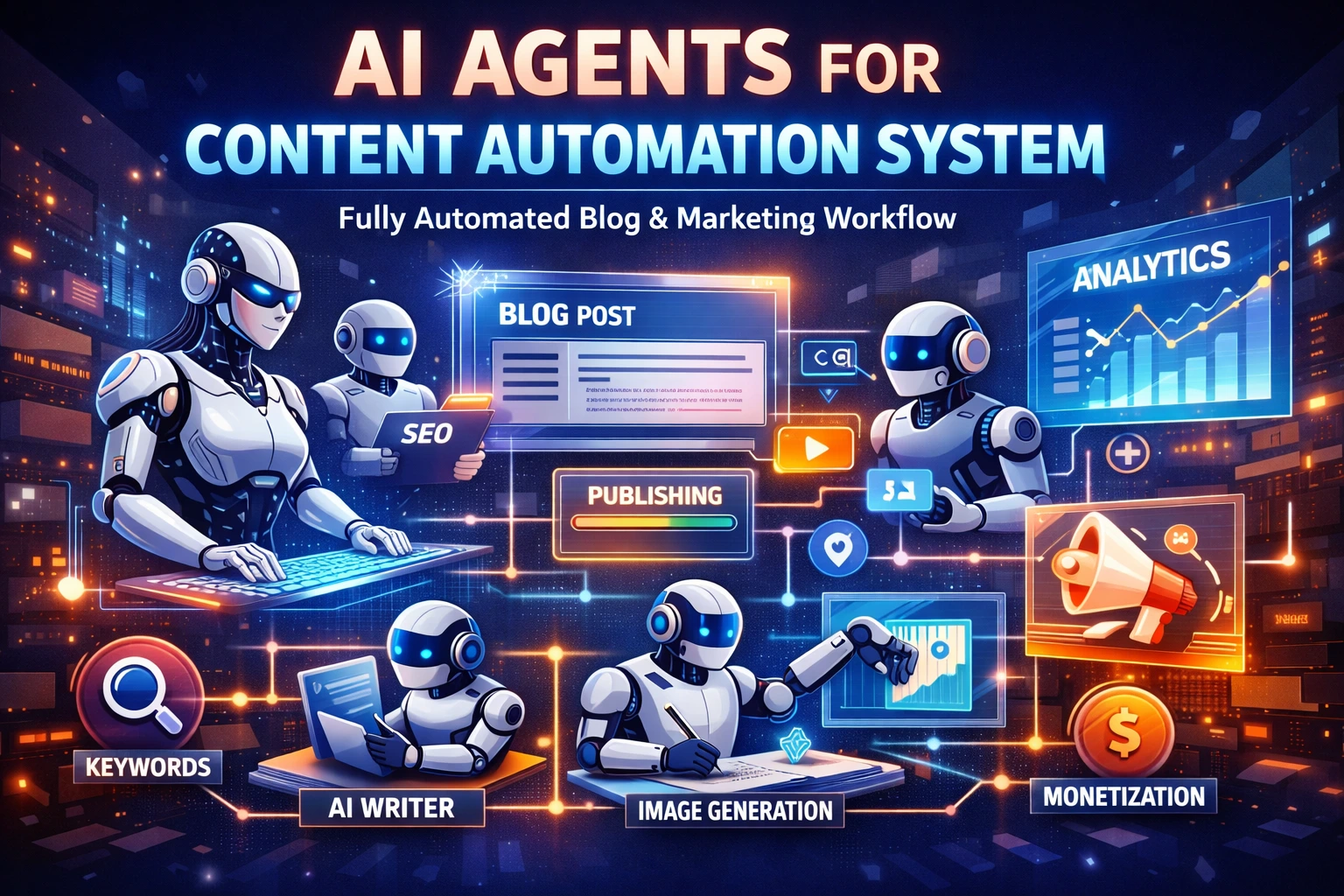
In 2026, the distinction between a “tool” and an “agent” has become the defining line between a struggling creator and a digital tycoon. While traditional AI tools (like the early versions of ChatGPT) required you to sit at the keyboard and provide constant prompts, AI Agents are autonomous digital workers. They don’t just write; they think, plan, and execute.
If you are still manually copying text from an AI into WordPress, you are working for the machine. This guide will show you how to make the machine work for you by building a Fully Automated Content Ecosystem.
If you are a beginner, Please follow this guide > AI Full Work System to understand the Prompts before you continue.
🤖 What are AI Agents? (The 2026 Definition)
An AI Agent is an autonomous system powered by a Large Language Model (LLM) that can use tools, access the internet, and make decisions to achieve a high-level goal.
The Multi-Agent Revolution
In 2026, we have moved from “Single Hero Models” to Multi-Agent Systems (MAS). Think of this as a virtual office where different agents have different jobs.
| Feature | Traditional Automation (Zapier) | AI Agents (2026) |
| Logic | “If This, Then That” (Linear) | Reasoning and Planning (Dynamic) |
| Adaptability | Breaks if the UI changes | Navigates changes autonomously |
| Decision Making | None (Pre-programmed) | Self-correcting based on goals |
| Data Handling | Simple data transfer | Semantic understanding of data |
🏗️ Step 1: Building the “Digital Assembly Line”
To automate a blog, you don’t need one “super-agent”; you need a specialized team. Using frameworks like CrewAI or LangGraph, you can assign “backstories” to your agents to ensure they perform with professional-grade accuracy.
The 2026 AI Content Team Roles
-
The Trend Scout (Research Agent): Uses “Deep Research” protocols (like OpenAI’s 2026 search integration) to find viral topics before they peak.
-
The SEO Architect (Strategy Agent): Analyzes the current AEO (Answer Engine Optimization) landscape to ensure your content is cited by Google’s AI Overviews.
-
The Narrative Lead (Writing Agent): Uses a high-context model like Claude 4.5 to write long-form content that maintains a consistent brand voice.
-
The Visual Director (Creative Agent): Connects to Leonardo AI or DALL-E 4 to generate custom featured images and mid-article infographics.
-
The Distribution Manager (Marketing Agent): Automatically reformats the blog post into a thread for X (formerly Twitter), a script for TikTok, and a LinkedIn carousel.
🛠️ Step 2: The Tech Stack of 2026
Building this system used to require deep coding knowledge. Today, it’s about choosing the right orchestration layer.
Best Frameworks Compared
-
CrewAI: Best for “Role-Based” automation. It’s the easiest to set up if you want your agents to behave like a team of employees.
-
LangGraph: The choice for “Production-Grade” systems. It allows for complex, non-linear loops where an agent can say, “This draft isn’t good enough; rewrite section 3,” before publishing.
-
OpenClaw: The 2026 open-source favorite for self-hosted agents that connect to messaging apps like Telegram or WhatsApp for remote control.
📈 Step 3: From Content to Revenue (Monetization 2026)
An automated blog is a “Digital Asset” that works 24/7. Here is how the most successful “AI-Preneurs” are monetizing in 2026:
The Income Diversification Table
| Monetization Method | Why it works in 2026 | Potential |
| AEO Brand Placement | Being the “source” for Google’s AI answers. | High Traffic |
| High-Ticket Affiliate | Agents find 2026 software launches and build review sites. | $2k–$10k/mo |
| Content-as-a-Service | Selling the output of your agents to other businesses. | Scalable |
| Digital Products | Agents identify “pain points” in comments and draft E-books. | Passive |
💬 Real-World Instance: The “Niche Site” Success Story
Scenario: Sarah builds a travel blog focused on “Sustainable Glamping in 2026.”
-
Morning: Her Research Agent notices a 400% spike in searches for “Eco-domes in Portugal.”
-
Afternoon: The agent team writes 5 articles, generates 15 photorealistic images of eco-domes, and optimizes them for SEO.
-
Evening: The Marketing Agent shares the content. By the time Sarah wakes up, she has 50 new affiliate clicks and two hotel partnership inquiries.
-
Cost: Sarah spent $0.40 in API credits.
-
Profit: $120 in commissions.
⚠️ The “AI Slop” Warning: Maintaining Quality
Google’s 2026 “Perspective” update focuses on E-E-A-T (Experience, Expertise, Authoritativeness, Trustworthiness). To avoid being penalized for “Scaled Content Abuse,” you must:
-
The 80/20 Rule: Let AI do 80% of the heavy lifting (drafting, formatting), but keep 20% human (final fact-check, adding personal anecdotes).
-
Grounding: Use RAG (Retrieval-Augmented Generation) to ensure your agents cite real-world data and not “hallucinations.”
❓ FAQ Section
1. Do I need to be a programmer to build AI Agents?
In 2026, no. “Low-code” platforms like Dify and Flowise allow you to build complex agentic workflows using a “drag-and-drop” interface.
2. Is AI content still ranking on Google?
Yes. Google has officially stated they reward helpful content, regardless of how it was produced. The key is providing unique value that isn’t just a copy of existing articles.
3. What is AEO, and why does it matter?
Answer Engine Optimization is the new SEO. It’s about structuring your content so that AI engines (Google Gemini, Perplexity, OpenAI Search) use your site as their primary source.
4. How much does it cost to run a fully automated system?
Depending on your volume, you can run a high-traffic blog for $20–$50 a month in API tokens, replacing a human team that would cost $5,000+.
5. Can AI agents handle video marketing?
Yes. Modern agents can script, generate voiceovers with ElevenLabs, and assemble videos using CapCut AI or Sora (now widely available in 2026).
6. What happens if the AI makes a mistake?
This is why “Human-in-the-Loop” (HITL) checkpoints are vital. You can set your agent to “Pause and Notify” you via Slack before it hits “Publish” on any post.
7. Which LLM is best for writing in 2026?
Claude 4.5 is currently favored for its creative nuance, while GPT-5.2 mini is the gold standard for logical, data-heavy SEO tasks.
8. Is it legal to monetize AI-generated content?
Yes. As of 2026, the US Copyright Office and EU guidelines allow for the monetization of AI-assisted works, though copyright protection for purely AI-generated text remains a gray area.
9. Can agents manage my social media comments?
Yes. You can deploy “Community Agents” that respond to user comments in your brand voice, boosting engagement and SEO signals.
10. How do I start today?
Pick a framework like CrewAI, connect it to your WordPress API, and start by automating just one task, like your daily news summary.
🏁 Conclusion: The 2026 Blueprint
The “Zero-Human” business is no longer science fiction; it is a competitive necessity. By moving from simple AI tools to Autonomous AI Agents, you can scale your content output by 1,000% while cutting costs by 90%.
The winners of 2026 won’t be those who work the hardest, but those who orchestrate the best.
Watch the YouTube full guide on how to Automate your your work.
Visual Guide on How to Build an AI Blog Agent
This video provides a deep dive into the orchestrator-worker architecture needed to build a professional-grade automated blog system.