The Future of Intelligent Machines in the Real World
Introduction
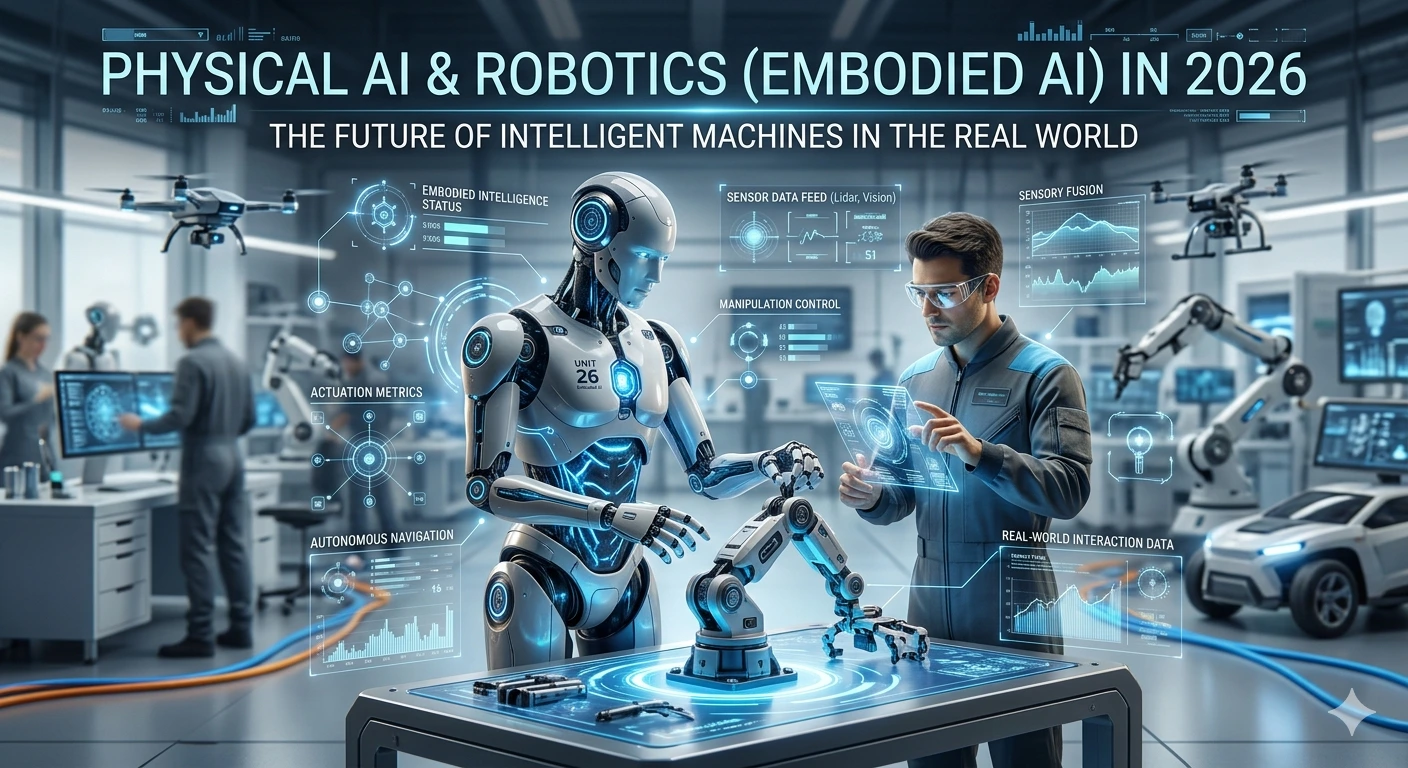
Artificial Intelligence has evolved far beyond algorithms that simply process data on screens. Today, a new frontier is emerging — Physical AI, also known as Embodied AI. This technology combines intelligence with physical form, enabling machines to see, move, interact, and learn directly from the real world.
From self-driving cars to humanoid robots and smart manufacturing systems, Physical AI is transforming industries, redefining labor, and shaping the future of human-machine interaction.
This article explores everything you need to know about Physical AI & Robotics — from core concepts and applications to real-world examples, benefits, challenges, and future possibilities.
What is Physical AI (Embodied AI)?
Physical AI (Embodied AI) refers to artificial intelligence systems that are integrated into physical entities, allowing them to interact with the real environment through sensors, actuators, and movement.
Unlike traditional AI, which operates purely in digital environments, Physical AI:
Perceives the physical world
Makes decisions in real time
Takes physical actions
Learns through interaction
Simple Definition
Physical AI is AI that has a body and can act in the real world.
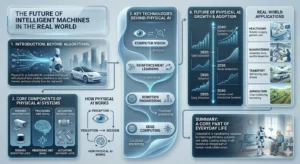
From digital algorithms to physical action: An architectural breakdown of how Embodied AI is redefining the interaction between machines and the real world.
Core Components of Physical AI Systems
1. Sensors (Perception Layer)
Sensors allow robots to understand their environment.
Allows machines to “see” and interpret visual data.
2. Reinforcement Learning
Enables learning through trial and error.
3. Robotics Engineering
Design and construction of physical machines.
4. Edge Computing
Processes data locally for real-time decisions.
5. Internet of Things (IoT)
Connects devices for data sharing and coordination.
Real-World Applications of Physical AI
1. Healthcare
Robotic surgery systems
Patient care robots
Rehabilitation devices
2. Manufacturing
Assembly line robots
Quality inspection systems
Predictive maintenance
3. Transportation
Self-driving cars
Delivery drones
Smart traffic systems
4. Agriculture
Crop monitoring
Automated harvesting
Soil analysis
5. Home Automation
Vacuum robots
Smart assistants
Security systems
6. Logistics & Warehousing
Inventory management
Package sorting
Automated delivery
Case Studies & Evidence-Based Examples
Case Study 1: Warehouse Robotics
Robots:
Navigate using sensors
Avoid obstacles
Optimize delivery routes
Result:
Faster processing
Reduced costs
Improved accuracy
Case Study 2: Autonomous Vehicles
Systems use:
Cameras + AI models
Real-time decision-making
Continuous learning
Evidence:
Human error causes over 90% of road accidents, which automation can significantly reduce.
Case Study 3: Healthcare Robotics
Improved surgical precision
Faster recovery
Reduced complications
Benefits of Physical AI
Efficiency
Precision
Safety
Scalability
Continuous learning
Challenges of Physical AI
High cost
Safety concerns
Ethical issues
Complexity
Data dependency
Ethical Considerations
Responsibility for errors
Job displacement
Fairness and accountability
Future of Physical AI
Trends
Human-robot collaboration
Smarter autonomous systems
Industry-wide expansion
Personalized robotics
Illustration: Growth of Physical AI Adoption
2020 → Early Adoption
2025 → Rapid Expansion
2030 → Mainstream Integration
2040 → Human-Level Interaction Systems
Physical AI Use Cases Summary
Industry
Use Case
Healthcare
Robotic surgery
Manufacturing
Automated assembly
Transport
Self-driving vehicles
Agriculture
Smart farming
Home
Cleaning robots
Logistics
Warehouse automation
Frequently Asked Questions (FAQs)
1. What is the difference between AI and Physical AI?
AI is digital; Physical AI operates in the real world.
2. Is Physical AI the same as robotics?
No. Robotics is the body; AI is the intelligence.
3. Are Physical AI systems safe?
Generally yes, but risks require proper regulation.
4. Will robots replace jobs?
Some roles will be automated, but new ones will emerge.
5. Which industries benefit most?
Healthcare, manufacturing, logistics, and transport.
6. Can Physical AI learn independently?
Yes, through machine learning and real-world interaction.
Summary
Physical AI, also known as Embodied AI, refers to intelligent systems embedded in physical machines that can perceive, act, and learn from real-world environments. It combines sensors, processing systems, and actuators to enable real-time interaction and decision-making.
This technology is already transforming industries such as healthcare, manufacturing, transportation, agriculture, and logistics by improving efficiency, precision, and safety. However, challenges like high costs, ethical concerns, and system complexity still need to be addressed.
Looking ahead, Physical AI is expected to become a core part of everyday life, with advancements in human-robot collaboration, smarter autonomous systems, and widespread industry adoption driving its growth.