The Future of Intelligent Automation
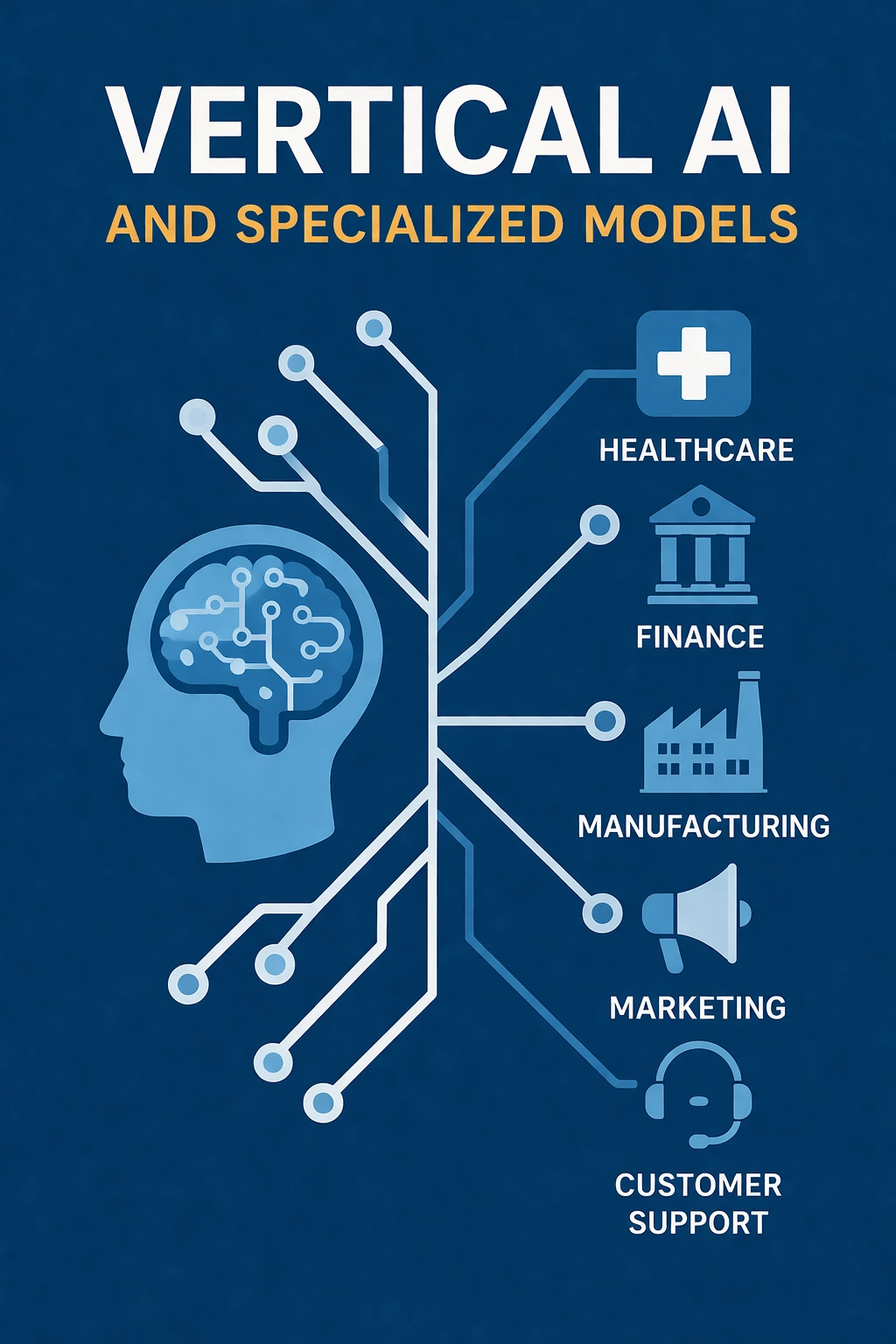
Artificial Intelligence is no longer just a futuristic concept—it is actively reshaping how businesses operate, compete, and scale. However, the real shift is happening beneath the surface. Instead of relying solely on broad, one-size-fits-all AI systems, organizations are now embracing Vertical AI and specialized models that deliver precise, industry-focused solutions.
Imagine an AI that doesn’t just “understand” language but deeply understands finance, healthcare, marketing, or legal systems. This is the power of vertical AI—technology designed not to do everything, but to do specific tasks exceptionally well.
From automating complex workflows to delivering highly accurate insights, specialized AI models are becoming the backbone of modern digital transformation. Businesses that leverage these systems gain a significant edge by improving efficiency, reducing costs, and making smarter decisions faster.
In this guide, you will explore how vertical AI works, why it is outperforming general AI in key industries, and how you can apply it to unlock new growth opportunities. You can also explore our detailed guide on Physical AI & Robotics (Embodied AI in 2026) to understand how AI is evolving beyond software into real-world applications:
Table of Contents
- Introduction to Vertical AI
- What Are Specialized AI Models?
- Vertical AI vs Horizontal AI
- Key Benefits of Vertical AI
- Real-World Examples Across Industries
- How Vertical AI Works (Architecture & Data)
- Comparison Table: General vs Specialized AI
- Challenges and Limitations
- Future Trends in Specialized AI
- Implementation Strategy for Businesses
- Conclusion
Vertical AI and Specialized Models
Artificial Intelligence is evolving rapidly, shifting from broad, general-purpose systems to highly focused, industry-specific solutions. This transformation has given rise to Vertical AI and specialized models, which are redefining how businesses use AI for real-world impact.
While general AI systems can perform a wide range of tasks, they often lack the depth required for complex, domain-specific applications. Vertical AI addresses this gap by delivering precision, efficiency, and reliability tailored to specific industries.
Introduction to Vertical AI
Vertical AI refers to artificial intelligence systems designed specifically for a single industry or use case, such as healthcare, finance, legal services, or marketing.
Unlike general AI, which is trained on diverse datasets, vertical AI models are trained on highly specialized data, enabling them to understand industry-specific terminology, workflows, and regulations.
Simple Illustration
- General AI = A general doctor
- Vertical AI = A heart surgeon
Both are knowledgeable, but the specialist delivers deeper expertise and more accurate outcomes in a specific domain.
What Are Specialized AI Models?
Specialized AI models are systems designed to perform narrow, well-defined tasks with high accuracy.
They include:
- Vertical AI – Industry-specific (e.g., finance, healthcare)
- Horizontal AI – Function-specific (e.g., marketing automation, HR tools)
- Task-specific AI – Built for a single operation (e.g., fraud detection)
These models outperform general AI in targeted applications because they rely on domain-specific training data and optimized architectures.
Vertical AI vs Horizontal AI
Understanding the difference is essential for building effective AI-driven systems.
Horizontal AI (General-Purpose)
- Works across multiple industries
- Examples: Chatbots, content generators
- Broad but less accurate in niche tasks
Vertical AI (Specialized)
- Built for a specific industry
- Deep domain expertise
- Higher accuracy and reliability
Key Insight
Horizontal AI provides breadth, while vertical AI delivers depth and precision.
Key Benefits of Vertical AI
1. Higher Accuracy
Vertical AI models are trained on industry-specific datasets, resulting in significantly improved performance in specialized tasks.
2. Industry Expertise
They understand technical language, compliance rules, and operational workflows unique to each sector.
3. Faster ROI
Businesses can also combine AI with online income strategies. For example, you can learn how to monetize AI tools in our guide on how beginners can make money using ChatGPT:
4. Better Decision-Making
By focusing on relevant data, vertical AI delivers actionable insights and predictive analytics.
5. Data Security and Compliance
Vertical AI solutions often operate within controlled environments, ensuring compliance with regulations like finance or healthcare standards.
6. Workflow Automation
They automate complex processes such as:
- Medical documentation
- Financial reporting
- Supply chain optimization
Real-World Examples Across Industries
Healthcare
- AI models analyze medical images and detect diseases
- Automate clinical documentation
- Improve diagnostic accuracy
Vertical AI in healthcare can interpret medical terminology and patient data more effectively than general AI.
Finance
- Fraud detection systems
- Risk assessment models
- Automated trading insights
Financial AI models analyze large datasets to identify patterns and anomalies in real time.
Manufacturing
- Predictive maintenance
- Quality control
- Process optimization
AI can detect equipment failures before they happen, reducing downtime and costs.
Marketing & SEO (High Relevance)
- Keyword clustering
- Content optimization
- Internal linking automation
If you want to turn AI-powered SEO into income, check out our guide on creating and selling AI templates using Canva and ChatGPT
Customer Support
- Intelligent chatbots trained on company-specific data
- Automated ticket resolution
- Personalized customer interactions
How Vertical AI Works (Architecture & Data)
Vertical AI systems typically rely on:
1. Domain-Specific Data
- Industry datasets
- Proprietary company data
- Structured internal knowledge
2. Model Fine-Tuning
General AI models are fine-tuned using specialized datasets to improve accuracy.
3. Retrieval-Augmented Generation (RAG)
This technique allows AI to:
- Access internal databases
- Provide context-aware responses
- Reduce hallucinations
4. Workflow Integration
Vertical AI integrates into tools like:
- CRM systems
- CMS platforms
- ERP software
Comparison Table: General AI vs Vertical AI
| Feature | General AI | Vertical AI |
|---|---|---|
| Scope | Broad | Narrow |
| Accuracy | Moderate | High |
| Training Data | General internet data | Industry-specific data |
| Flexibility | High | Limited |
| Setup Time | Low | Moderate |
| ROI | Slower | Faster |
| Use Case | Content generation | Specialized automation |
Challenges and Limitations
Despite its advantages, vertical AI comes with several challenges:
1. Data Dependency
High-quality domain data is required, which can be expensive or difficult to obtain.
2. Limited Flexibility
Vertical AI performs poorly outside its domain.
3. Development Costs
Building specialized models requires investment in:
- Data collection
- Model training
- Maintenance
4. Scalability Issues
Expanding to multiple industries requires separate models and datasets.
Future Trends in Specialized AI
1. Rise of AI Agents
Autonomous agents performing tasks without human input are becoming mainstream.
2. Industry-Specific SaaS + AI
Vertical SaaS platforms will integrate AI for automation and analytics.
3. Smaller, Efficient Models
Specialized AI requires less computational power than large general models.
4. Data Ownership and Privacy
Companies will prioritize private AI models trained on internal data.
5. Hyper-Automation
Entire workflows—from data input to decision-making—will be automated.
Implementation Strategy for Businesses
Step 1: Identify a Specific Use Case
Focus on a narrow, high-value problem (e.g., SEO automation, customer support).
Step 2: Collect Quality Data
Structure internal data such as:
- Customer records
- Content databases
- Financial data
Step 3: Choose the Right Model
- Fine-tuned LLM
- Custom-built AI
- Hybrid approach (RAG + LLM)
Step 4: Integrate into Workflow
Embed AI into:
- Website CMS
- CRM tools
- Automation platforms
Step 5: Monitor and Optimize
Continuously improve model performance using feedback and new data.
Conclusion
Vertical AI and specialized models represent the next phase of artificial intelligence evolution. While general AI provides flexibility, vertical AI delivers precision, reliability, and real business value.
Organizations that adopt specialized AI solutions gain:
- Competitive advantage
- Faster automation
- Better decision-making
The future of AI is not about building systems that can do everything—it’s about creating systems that do one thing exceptionally well.
To stay ahead, businesses and individuals must learn how to integrate AI into daily workflows. You can start by exploring practical strategies in our guide on how to speed up your workflow using simple AI techniques