Introduction
Artificial Intelligence is no longer something meant only for programmers, big companies, or technology experts. Today, students, bloggers, freelancers, business owners, teachers, marketers, writers, job seekers, and content creators are using AI tools every day to save time, create ideas, solve problems, and improve productivity.
But there is one major problem.
Many people open ChatGPT, Gemini, Claude, DeepSeek, or any other AI tool and simply type short instructions like:
“Write something for me.”
“Give me ideas.”
“Create content.”
“Explain this.”
Then they become disappointed when the result is too simple, too general, too boring, or not exactly what they wanted.
The problem is not always the AI tool. Most times, the problem is the prompt.
A prompt is the instruction you give to an AI system. Prompt engineering is the skill of writing clear, detailed, useful, and well-structured instructions so that AI can give you better answers.
In this full class, you will learn AI prompt engineering from beginner level to professional practical level. You will understand how to write prompts for learning, blogging, business, freelancing, research, coding, social media, marketing, content creation, customer service, and daily productivity.
This class is written in a simple way so that both beginners and professionals can understand it.
By the end of this class, you will not just know what prompt engineering means. You will know how to command AI like someone who understands what they are doing.
To understand how AI tools work in real life, you can also read our
AI Tools Reviews.
You can continue learning from our full
AI Tutorials section.
If you want to use AI for income ideas, visit our
Make Money Online with AI category.
What Is AI Prompt Engineering?
AI prompt engineering is the process of writing clear and effective instructions for an artificial intelligence tool so that it can produce better, more accurate, and more useful results.
A prompt can be a question, command, task, instruction, example, role, format, or full direction given to an AI tool.
For example, this is a weak prompt:
“Write an article about AI.”
This is a better prompt:
“Write a beginner-friendly 1,500-word blog post about how small business owners can use AI in 2026. Use simple English, include examples, add subheadings, and make the tone practical and encouraging.”
The second prompt is better because it tells the AI:
- the topic
- the audience
- the year
- the length
- the tone
- the format
- the style
- the purpose
That is the heart of prompt engineering.
Prompt engineering is not about using big grammar. It is about giving AI the right direction.
Why Prompt Engineering Is Important in 2026
AI tools are becoming more powerful, but the quality of your output still depends heavily on the quality of your input.
A person who knows how to write good prompts can use AI to:
create better blog posts, write business plans, generate social media content, summarize long documents, create lesson notes, plan marketing campaigns, write emails, design workflows, research ideas, solve problems, learn new skills, generate code, compare products, and automate simple tasks.
In 2026, prompt engineering is becoming a basic digital skill. It is like knowing how to search on Google years ago. People who understand how to ask AI properly will get better results than people who only type short and unclear commands.
For bloggers, prompt engineering can help with article planning, keyword ideas, outlines, introductions, FAQs, meta descriptions, internal linking ideas, and content improvement.
For students, it can help with explanations, study plans, summaries, quiz questions, and topic breakdowns.
For business owners, it can help with customer replies, product descriptions, WhatsApp messages, sales copy, business proposals, and social media captions.
For freelancers, it can help with client work, proposals, portfolio descriptions, content creation, and productivity.
Prompt engineering is not just an AI skill. It is a communication skill.
Class 1: Understanding How AI Responds to Prompts
Before you can write better prompts, you need to understand how AI responds.
AI tools do not read your mind. They respond based on the instruction you give, the context you provide, the examples you include, and the format you request.
When your prompt is too short, AI has to guess what you mean.
For example:
“Write about business.”
This is too open. AI may not know whether you want:
a business idea, business plan, business article, business caption, business email, business proposal, business strategy, business name, or business lesson.
A better prompt gives direction:
“Write a simple business article for beginners explaining five small businesses someone can start with low capital in Africa. Use a friendly tone and include practical examples.”
Now the AI understands the assignment better.
AI works better when you give it:
clear topic, target audience, purpose, tone, format, examples, limitations, and expected output.
That is why prompt engineering matters.
Class 2: The Difference Between a Bad Prompt and a Good Prompt
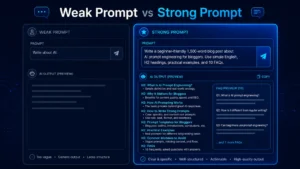
A bad prompt is unclear. It forces AI to guess.
A good prompt is specific. It gives AI direction.
Bad prompt:
“Write content.”
Good prompt:
“Write a 1,200-word blog post for beginners about how to use ChatGPT for studying. Use simple English, short paragraphs, H2 headings, examples, and 10 FAQs.”
Bad prompt:
“Give me business ideas.”
Good prompt:
“Give me 20 online business ideas that a beginner in Nigeria, Ghana, or The Gambia can start with low capital in 2026. Include required skills, possible tools, and how to get first customers.”
Bad prompt:
“Make this better.”
Good prompt:
“Rewrite this paragraph to sound more professional, simple, and persuasive. Keep the original meaning, correct grammar errors, and make it suitable for a business website.”
A good prompt reduces confusion.
Class 3: The Basic Prompt Formula
A strong prompt usually has five parts:
Task + Topic + Audience + Style + Format
Let us break it down.
The task tells AI what to do.
Example:
“Write,” “Explain,” “Summarize,” “Compare,” “Create,” “Rewrite,” “Analyze,” “Generate,” “Plan.”
The topic tells AI what the content is about.
Example:
“AI prompt engineering,” “small business automation,” “blogging with AI,” “email marketing,” “student productivity.”
The audience tells AI who the content is for.
Example:
“beginners,” “students,” “small business owners,” “freelancers,” “bloggers,” “professionals.”
The style tells AI how it should sound.
Example:
“simple,” “professional,” “friendly,” “motivational,” “formal,” “educational,” “conversational.”
The format tells AI how to arrange the answer.
Example:
“table,” “step-by-step guide,” “bullet list,” “blog post,” “email,” “FAQ section,” “lesson format.”
Full example:
“Write a beginner-friendly step-by-step guide about AI prompt engineering for bloggers. Use simple English, practical examples, short paragraphs, and include FAQs at the end.”
This formula alone can improve your AI results.
Class 4: Role Prompting
Role prompting means telling the AI to act like a specific expert before giving the task.
For example:
“Act as an experienced SEO content writer.”
“Act as a business coach.”
“Act as a university lecturer.”
“Act as a social media strategist.”
“Act as a WordPress expert.”
“Act as a customer service manager.”
Role prompting helps the AI choose the right tone, knowledge style, and structure.
Weak prompt:
“Write a blog post about AI tools.”
Better role prompt:
“Act as an experienced SEO content writer. Write a beginner-friendly blog post about the best ways to use AI tools for online business in 2026. Use practical examples and a clear structure.”
Role prompting is useful when you want expert-style output.
However, do not only depend on role prompting. You still need to give clear instructions.
Class 5: Context Prompting
Context is background information that helps AI understand your situation.
Without context, AI may give general answers.
For example:
“Write a homepage introduction.”
This is not enough.
Better prompt with context:
“I run a website called Gistrol.com. The site teaches AI tutorials, AI tools, prompt engineering, AI automation, and ways to make money online with AI. Write a homepage introduction for beginners and professionals. Make it simple, attractive, and SEO-friendly.”
Now the AI knows what the website is about.
Context can include:
your business name, target audience, location, goal, product, service, problem, tone, platform, and desired result.
Context makes AI output more personal and useful.
Class 6: Instruction Prompting
Instruction prompting means giving AI clear rules to follow.
For example:
“Use simple English.”
“Do not use complicated words.”
“Write in short paragraphs.”
“Use H2 and H3 headings.”
“Do not repeat ideas.”
“Include examples.”
“Make it suitable for beginners.”
“Keep the tone professional.”
“Do not use fake statistics.”
“Do not mention things you are not sure about.”
This is very important when creating content for a website.
Example prompt:
“Write a 2,000-word SEO article about AI automation for small businesses. Use simple English, short paragraphs, H2 headings, practical examples, and FAQs. Do not use fake statistics or unsupported claims.”
This helps control the result.
Class 7: Format Prompting
Sometimes, the content is good but the arrangement is poor. Format prompting solves this.
You can ask AI to produce content in a specific format.
Examples:
“Create a table.”
“Write in lesson format.”
“Use numbered steps.”
“Use H2 headings.”
“Create a checklist.”
“Write as a blog post.”
“Create a comparison table.”
“Write as an email template.”
“Create a content calendar.”
Example:
“Create a 30-day AI learning plan for beginners. Arrange it in a table with Day, Topic, Task, and Practice Exercise.”
Format prompting helps you get content that is easy to read and easy to use.
Class 8: Example-Based Prompting
AI performs better when you give examples.
This is called example-based prompting.
For example:
“Write five YouTube titles like these examples:
- How to Use ChatGPT to Make Money Online
- 7 AI Tools Every Beginner Should Know
- How I Use AI to Save 3 Hours Daily
Now create 10 similar titles for AI prompt engineering.”
When you give examples, AI understands the style you want.
This is useful for:
headlines, captions, emails, product descriptions, blog titles, ad copy, hooks, introductions, and social media content.
Example-based prompting is one of the easiest ways to improve output quality.
Class 9: Step-by-Step Prompting
Step-by-step prompting means asking AI to break a task into stages.
Instead of asking:
“Create a business plan.”
You can ask:
“Create a business plan step by step. Start with business idea, target audience, problem, solution, pricing, marketing strategy, startup cost, and 30-day action plan.”
Step-by-step prompting is powerful because it makes AI slow down and organize the answer better.
Example:
“Teach me AI prompt engineering step by step as if I am a complete beginner. Start from the meaning, then examples, then formulas, then practice exercises.”
This style is perfect for learning.
Class 10: Prompt Engineering for Blogging
Bloggers can use prompt engineering to create better content faster.
But you must be careful. AI should not replace your thinking. It should support your writing.
Here are useful blogging prompts.
Blog Topic Prompt
“Give me 20 low-competition blog topic ideas under AI prompt engineering for beginners. Make them practical, SEO-friendly, and suitable for a website that teaches AI tutorials.”
Blog Outline Prompt
“Create a detailed blog outline for the topic ‘AI Prompt Engineering Full Class 2026.’ Use H2 and H3 headings. Make it beginner-friendly, practical, and SEO optimized.”
Introduction Prompt
“Write a catchy blog introduction for an article about AI prompt engineering. Make it simple, engaging, and suitable for beginners who want to learn how to use ChatGPT, Gemini, Claude, and other AI tools.”
SEO Meta Description Prompt
“Write five SEO meta descriptions for this title: ‘AI Prompt Engineering Full Class 2026.’ Each one should be short, clear, attractive, and include the main keyword.”
FAQ Prompt
“Create 15 FAQs about AI prompt engineering for beginners. Give simple and helpful answers.”
Content Improvement Prompt
“Improve this article for readability. Make the sentences shorter, remove repetition, improve flow, and keep the original meaning.”
Bloggers should always review, edit, fact-check, and add personal experience before publishing AI-assisted content.
Class 11: Prompt Engineering for Students
Students can use prompt engineering to learn faster and understand difficult topics.
Useful student prompts:
“Explain photosynthesis like I am 12 years old.”
“Summarize this topic in simple English.”
“Create 20 quiz questions from this lesson.”
“Make a study timetable for my exam in two weeks.”
“Explain this topic with real-life examples.”
“Compare these two concepts in a table.”
“Give me practice questions and answers.”
Example:
“Act as a patient teacher. Explain AI prompt engineering to a beginner student. Use simple examples, avoid technical grammar, and give practice exercises.”
Students should not use AI to cheat. They should use it to understand better, practice more, and improve learning.
Class 12: Prompt Engineering for Business Owners
Business owners can use AI prompts to save time and communicate better.
Useful business prompts:
“Write a WhatsApp reply for a customer asking about my service.”
“Create a product description for my online store.”
“Write a professional business proposal.”
“Create a 7-day social media content plan for my business.”
“Write a polite response to an angry customer.”
“Create a simple sales message for my product.”
Example:
“Act as a customer service manager. Write a polite WhatsApp response to a customer who is asking about delivery delay. Apologize, explain professionally, and reassure the customer.”
Prompt engineering can help small businesses look more professional.
Class 13: Prompt Engineering for Freelancers
Freelancers can use prompt engineering to improve client communication, proposals, content delivery, and productivity.
Useful freelancer prompts:
“Write a professional proposal for a client who needs website design.”
“Create a portfolio description for my graphic design service.”
“Rewrite this message to sound more confident and polite.”
“Create a pricing package for my freelance writing service.”
“Write a client follow-up message after sending a quotation.”
Example:
“Act as a freelance business coach. Help me write a professional message to a client who has delayed payment. Make it polite, firm, and respectful.”
Freelancers who know prompt engineering can work faster and communicate better.
Class 14: Prompt Engineering for Social Media
Social media needs strong hooks, simple captions, and clear calls to action.
Useful social media prompts:
“Create 20 Facebook post ideas about AI tools for beginners.”
“Write 10 short Instagram captions about learning AI.”
“Create a viral-style hook for a post about prompt engineering.”
“Write a LinkedIn post about how AI can improve productivity.”
“Create a 7-day social media content calendar for an AI tutorial website.”
Example:
“Write 10 attention-grabbing hooks for a Facebook post teaching beginners how to use ChatGPT prompts. Make them simple, emotional, and practical.”
Good prompts help you create content faster, but you should still add your voice.
Class 15: Prompt Engineering for Email Writing
AI can help you write clear, professional emails.
Useful email prompts:
“Write a professional email requesting a meeting.”
“Rewrite this email to sound polite and direct.”
“Create a follow-up email after a business proposal.”
“Write a customer support email apologizing for delay.”
“Write an email introduction for my new AI class.”
Example:
“Write a professional email to invite beginners to join my AI Prompt Engineering Full Class 2026. Make it friendly, clear, and persuasive.”
Email prompt formula:
Purpose + recipient + tone + details + call to action.
Example:
“Write an email to website subscribers announcing a new AI prompt engineering class. Use a friendly tone, explain the benefits, and invite them to read the full lesson.”
Class 16: Prompt Engineering for Research
AI can help organize research, but you should not blindly trust everything it says.
Useful research prompts:
“Explain this topic in simple terms.”
“Give me possible angles for researching this subject.”
“Create a comparison table.”
“List important questions I should ask about this topic.”
“Summarize the main arguments for and against this idea.”
“Create a research outline.”
Example:
“Create a research outline for the topic ‘How AI prompt engineering improves productivity.’ Include introduction, key points, examples, challenges, and conclusion.”
Important warning: AI can make mistakes. Always verify important facts from trusted sources before publishing.
Class 17: Prompt Engineering for Coding
Even if you are not a professional programmer, you can use AI to explain code, fix errors, and create simple tools.
Useful coding prompts:
“Explain this code line by line.”
“Find the error in this code.”
“Write HTML and CSS for a simple landing page.”
“Create a WordPress CSS fix for mobile view.”
“Explain this JavaScript in beginner-friendly language.”
Example:
“Act as a patient coding teacher. Explain this CSS code line by line and tell me what each part does.”
For better coding results, include:
the language, the problem, the error message, what you expected, what happened, and the full code if possible.
Class 18: Prompt Engineering for WordPress and SEO
Website owners can use prompt engineering to improve content, page structure, metadata, and readability.
Useful WordPress and SEO prompts:
“Create an SEO title for this blog post.”
“Write a meta description under 160 characters.”
“Suggest internal links for this article.”
“Create FAQ schema content for this topic.”
“Rewrite this paragraph for better readability.”
“Give me a homepage structure for an AI tutorial website.”
Example:
“Act as an SEO content strategist. Create a homepage content structure for an AI tutorial website called Gistrol. The site teaches AI tools, prompt engineering, AI tutorials, and ways to make money online with AI.”
For SEO, your prompts should mention:
main keyword, audience, search intent, headings, meta description, FAQs, and readability.
Class 19: Advanced Prompt Formula
When you want high-quality output, use this advanced formula:
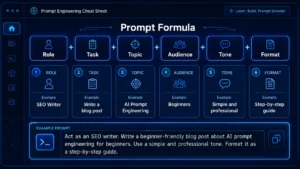
Role + Context + Task + Audience + Requirements + Format + Limitations
Example:
“Act as an SEO content writer. I run an AI tutorial website for beginners and professionals. Write a 2,000-word blog post about AI prompt engineering in 2026. The audience is beginners who use ChatGPT, Gemini, Claude, and DeepSeek. Use simple English, H2 headings, examples, prompt formulas, and FAQs. Do not use fake statistics. Format it as a full class.”
This prompt is strong because it gives complete direction.
Here is the structure:
Role: SEO content writer
Context: AI tutorial website
Task: write blog post
Audience: beginners
Requirements: simple English, examples, FAQs
Format: full class
Limitations: no fake statistics
This is how professionals prompt AI.
Class 20: Prompt Refinement
Prompt refinement means improving your prompt when the first answer is not good enough.
You do not need to accept the first AI response.
You can ask:
“Make it more detailed.”
“Make it simpler.”
“Add examples.”
“Remove repetition.”
“Make it more professional.”
“Rewrite for beginners.”
“Add a table.”
“Add FAQs.”
“Make the tone more persuasive.”
“Shorten the sentences.”
Example:
First prompt:
“Write about prompt engineering.”
Follow-up prompt:
“Make it more practical. Add examples for bloggers, students, business owners, and freelancers. Use simple English and short paragraphs.”
Prompt engineering is not always one command. Sometimes, it is a conversation.
Class 21: Common Prompt Engineering Mistakes
Many beginners make simple mistakes when using AI.
Mistake 1: Giving Very Short Prompts
Short prompts usually produce general answers.
Instead of:
“Write about AI.”
Use:
“Write a beginner-friendly guide about how AI can help small business owners save time in 2026. Use examples and simple language.”
Mistake 2: Not Giving Context
AI needs background information.
Instead of:
“Write my About page.”
Use:
“I run a website called Gistrol.com that teaches AI tutorials, AI tools, prompt engineering, and ways to make money online with AI. Write a professional About page for the website.”
Mistake 3: Not Stating the Audience
Content for students is different from content for business owners.
Always say who the content is for.
Mistake 4: Not Choosing a Format
If you want a table, ask for a table.
If you want a lesson, ask for a lesson.
If you want FAQs, ask for FAQs.
Mistake 5: Trusting AI Without Review
AI can make mistakes. Always review important content before publishing.
Mistake 6: Asking for Too Many Things at Once
Sometimes, a prompt becomes too crowded. Break large tasks into smaller steps.
Example:
First ask for outline.
Then ask for introduction.
Then ask for full article.
Then ask for FAQs.
Then ask for SEO metadata.
This gives better control.
Class 22: Best Prompt Templates for Beginners
Here are practical prompt templates you can start using today.
General Learning Prompt
“Explain [topic] to me like I am a beginner. Use simple English, examples, and step-by-step explanation.”
Blog Post Prompt
“Write a [number]-word SEO blog post about [topic]. The audience is [audience]. Use simple English, H2 headings, examples, FAQs, and a helpful conclusion.”
Business Prompt
“Act as a business consultant. Help me create [business task] for [type of business]. Make it practical, simple, and professional.”
Social Media Prompt
“Create [number] social media post ideas about [topic] for [platform]. Make them engaging, simple, and useful for [audience].”
Email Prompt
“Write a professional email to [recipient] about [purpose]. Use a [tone] tone and include [important details].”
Rewrite Prompt
“Rewrite this text to sound more [tone]. Keep the original meaning, correct grammar errors, and make it clearer.”
SEO Prompt
“Act as an SEO expert. Suggest SEO title, slug, meta description, tags, and FAQ ideas for this topic: [topic].”
Research Prompt
“Create a research outline for [topic]. Include main sections, key questions, possible arguments, and practical examples.”
Prompt Improvement Prompt
“Improve this prompt so it gives a clearer and more useful AI response: [paste prompt].”
Class 23: How to Build Your Own Prompt Library
A prompt library is a collection of prompts you can reuse.
Instead of writing from scratch every time, you save your best prompts.
Your prompt library can include:
blog prompts, SEO prompts, email prompts, business prompts, customer service prompts, social media prompts, research prompts, design prompts, coding prompts, and learning prompts.
You can organize your prompt library like this:
| Category | Prompt Use | Example |
|---|---|---|
| Blogging | Article writing | Write a full SEO blog post about… |
| SEO | Meta description | Create five meta descriptions for… |
| Business | Customer reply | Write a polite reply to… |
| Social Media | Captions | Create 10 captions about… |
| Learning | Explanation | Explain this topic like I am a beginner |
| Freelancing | Client message | Write a professional proposal for… |
A prompt library saves time and makes your AI workflow faster.
Class 24: Practical Prompt Engineering Exercises
To become good at prompt engineering, you must practice.
Exercise 1: Improve a Weak Prompt
Weak prompt:
“Write about AI.”
Improved prompt:
“Write a beginner-friendly article about how AI helps students study better in 2026. Use simple English, examples, and practical tips.”
Now create your own improved version.
Exercise 2: Add Context
Weak prompt:
“Write a business message.”
Improved prompt:
“I sell handmade shoes online. Write a polite WhatsApp message to a customer who asked about price, delivery time, and payment method.”
Now create your own version for your business.
Exercise 3: Create a Blog Prompt
Write a prompt that asks AI to create a full blog post about any topic you like.
Include:
topic, audience, length, tone, format, examples, and FAQs.
Exercise 4: Create a Social Media Prompt
Ask AI to create 10 Facebook posts for an AI tutorial page.
Exercise 5: Create a Prompt Library
Create five reusable prompts for your daily work.
Class 25: Complete Prompt Engineering Example
Let us build one full professional prompt together.
Goal: You want to create a blog post about AI tools for beginners.
Weak prompt:
“Write about AI tools.”
Professional prompt:
“Act as an experienced SEO content writer. Write a 2,000-word beginner-friendly blog post about the best ways to use AI tools in 2026. The audience is students, bloggers, freelancers, and small business owners. Use simple English, short paragraphs, H2 and H3 headings, practical examples, a comparison table, common mistakes, FAQs, and a helpful conclusion. Do not use fake statistics. Make the content original, readable, and useful.”
This prompt is strong because it is clear, detailed, and controlled.
AI Prompt Engineering Cheat Sheet
Use this whenever you want to write a strong prompt.
| Prompt Part | What It Means | Example |
|---|---|---|
| Role | Who AI should act as | Act as an SEO expert |
| Task | What AI should do | Write a blog post |
| Topic | Subject of the task | AI prompt engineering |
| Audience | Who it is for | Beginners |
| Tone | How it should sound | Simple and professional |
| Format | How it should be arranged | H2 headings and FAQs |
| Context | Background information | I run an AI tutorial website |
| Limit | What to avoid | Do not use fake statistics |
| Output | Final result expected | Full article with FAQs |
Best Prompt Engineering Structure to Remember
Use this structure:
Act as [role]. I need [task] about [topic] for [audience]. Use [tone]. Include [requirements]. Format it as [format]. Avoid [limitations].
Example:
“Act as an AI tutor. I need a beginner-friendly lesson about prompt engineering for students and bloggers. Use simple English. Include examples, practice exercises, and FAQs. Format it as a full class. Avoid complicated technical language.”
This structure works for most AI tasks.
How to Use Prompt Engineering Responsibly
Prompt engineering is powerful, but you should use it responsibly.
Do not use AI to spread false information.
Do not copy and publish AI output without reviewing it.
Do not use AI to impersonate people.
Do not use AI to create harmful instructions.
Do not use AI to deceive customers.
Always check important facts. Always edit content before publishing. Always add human judgment.
AI should help you work better, not make you careless.
Final Project: Build Your First Professional Prompt
Now let us create a final project.
Choose one task:
write a blog post, create a business plan, prepare a lesson note, write a customer message, create social media captions, or build a content calendar.
Use this template:
“Act as [expert role]. I want you to help me [task]. My audience is [audience]. The topic is [topic]. Use [tone]. Include [requirements]. Format the answer as [format]. Avoid [things to avoid]. Make the result practical and easy to understand.”
Example final project prompt:
“Act as an AI business coach. I want you to help me create a 30-day content plan for a small AI tutorial website. My audience is beginners who want to learn AI tools and prompt engineering. Use a simple and practical tone. Include daily topics, short descriptions, and suggested platforms. Format the answer as a table. Avoid complicated language and fake statistics.”
Practice this every day. The more you write prompts, the better you become.
Conclusion
AI prompt engineering is one of the most useful digital skills to learn in 2026. It helps you get better answers from AI tools, save time, create better content, communicate professionally, learn faster, and improve your productivity.
The secret is simple.
Do not just ask AI random questions. Give it direction.
Tell AI the role, task, topic, audience, tone, format, context, and limitations.
A weak prompt gives weak results.
A strong prompt gives stronger results.
Whether you are a blogger, student, freelancer, business owner, teacher, marketer, or beginner, prompt engineering can help you use AI more effectively.
Start with simple prompts. Practice every day. Save your best prompts. Improve them over time.
That is how you move from beginner to professional.
FAQs About AI Prompt Engineering
1. What is AI prompt engineering?
AI prompt engineering is the skill of writing clear and effective instructions for AI tools so they can give better answers.
2. Is prompt engineering only for programmers?
No. Prompt engineering is for everyone. Bloggers, students, business owners, freelancers, teachers, and marketers can all use it.
3. Why are my AI results not good?
Your AI results may be poor because your prompt is too short, unclear, or missing context. Better prompts usually give better results.
4. What makes a good prompt?
A good prompt includes the task, topic, audience, tone, format, context, and clear instructions.
5. Can prompt engineering help bloggers?
Yes. Bloggers can use prompt engineering for topic ideas, outlines, introductions, FAQs, meta descriptions, and content improvement.
6. Can students use prompt engineering?
Yes. Students can use prompts to understand topics, summarize notes, create quizzes, and prepare study plans.
7. Can AI prompts help small businesses?
Yes. Businesses can use prompts for customer replies, product descriptions, social media posts, emails, proposals, and marketing ideas.
8. What is role prompting?
Role prompting means telling AI to act like a specific expert, such as an SEO writer, teacher, business coach, or customer service manager.
9. What is context prompting?
Context prompting means giving AI background information so it understands your situation better.
10. What is a prompt template?
A prompt template is a reusable prompt structure that you can edit for different tasks.
11. Do I need paid AI tools to learn prompt engineering?
No. You can start learning prompt engineering with free AI tools. Paid tools may offer extra features, but the skill starts with clear instructions.
12. Can prompt engineering make AI answers perfect?
No. Prompt engineering improves AI answers, but you still need to review, edit, and verify important information.
13. What is the best prompt formula for beginners?
A simple formula is: Task + Topic + Audience + Tone + Format.
Example: “Write a beginner-friendly guide about AI tools for students. Use simple English and examples.”
14. How can I improve a bad prompt?
Add more details. Include the audience, purpose, tone, format, examples, and what you want the AI to avoid.
15. Is prompt engineering still useful in 2026?
Yes. As AI tools become more common, knowing how to give clear instructions becomes even more important.
16. Can I use prompt engineering to make money online?
Yes. You can use prompt engineering for freelancing, content writing, social media management, blogging, marketing, customer support, and business automation.
17. What is the biggest prompt engineering mistake?
The biggest mistake is giving short and unclear instructions, then expecting perfect results.
18. Should I copy AI content directly?
No. Always review, edit, fact-check, and improve AI content before publishing.
19. How long should a prompt be?
A prompt should be long enough to explain what you want clearly. It does not have to be very long, but it must be specific.
20. How do I become good at prompt engineering?
Practice daily, study good prompts, save your best templates, test different styles, and keep improving your instructions.