Introduction
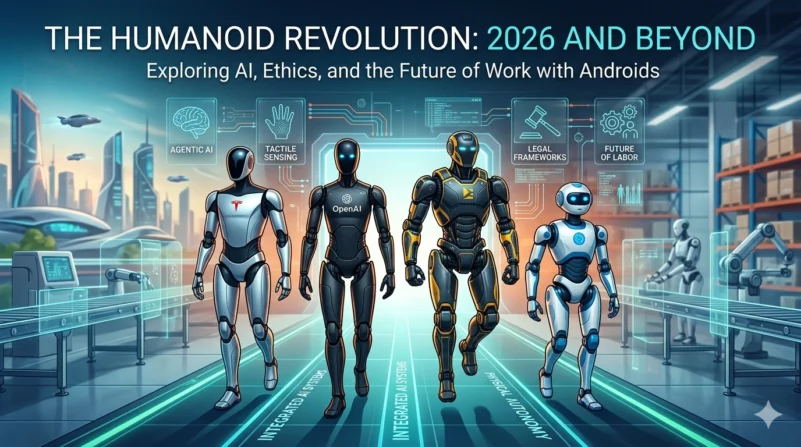
Honestly, if you told someone five years ago that a robot would be frothing their morning cappuccino and hauling construction materials by 2026, they’d probably tell you to stop watching so much sci-fi. Yet, here we are. “Physical AI” has officially hit the mainstream.
We’ve moved past the era of machines that just follow a script. Today’s humanoids are smart—like, scary smart. They use something called Agentic AI to figure out how to navigate our world, from opening doors to assisting nurses in hospitals.
It’s happening everywhere: factory floors in the US, care centers in Japan, and everywhere in between. The “Humanoid Robot” isn’t just a gadget anymore; it’s a new member of the global workforce.
Table of Contents
-
What is a Humanoid Robot?
-
The 2026 Landscape: Why Now?
-
The Titans of Tech: A Comparative Analysis
-
How They Work: The Anatomy of an Android
-
Industry Impact: Where They Are Working Today
-
Ethical Dilemmas: The Human-Robot Divide
-
The Economics of Automation: Costs vs. Benefits
-
FAQs
-
Summary: A New Species of Tool
1. What is a Humanoid Robot?
At its core, a humanoid robot is a professional-grade machine designed with a body structure that mimics the human form. This usually includes a torso, a head, two arms, and two legs.
Why the Human Form?
You might wonder: If we want a robot to vacuum, why not make it a disc? If we want it to move boxes, why not a forklift? The answer lies in General Purpose Utility. Our entire world—stairs, door handles, narrow hallways, and power tools—is built for the human shape. By creating robots that look like us, we don’t have to redesign our billion-dollar infrastructures. We simply “plug” the robot into the existing environment.
2. The 2026 Landscape: Why Now?
Three major technological “convergences” have made 2026 the breakout year for humanoids:
-
Generative Physical AI: Just as ChatGPT learned to speak by reading the internet, humanoids now learn to move by watching millions of hours of human video. This is known as End-to-End Neural Training.
-
High-Torque Actuators: Improvements in battery density and electric motors (actuators) mean robots can now exert the force of a professional athlete while maintaining the delicacy to pick up a strawberry.
-
The Labor Gap: With aging populations in the West and East Asia, there are simply not enough humans to fill “Dull, Dirty, and Dangerous” jobs. Humanoids are no longer a luxury; they are a demographic necessity.
3. The Titans of Tech: A Comparative Analysis
In 2026, the market is no longer a monopoly. Several “megabots” are vying for dominance. Here is how the top contenders stack up:
Comparison Table: Leading Humanoid Robots (2026)
| Feature | Tesla Optimus (Gen 3) | Figure 02 | Boston Dynamics Atlas (Electric) | Unitree G1 |
| Primary Use | Factory / Home Assistant | Industrial Logistics | Heavy Industry / SAR | General Purpose / Research |
| Height | 173 cm | 170 cm | 165 cm | 130 cm |
| Max Payload | 22 kg | 25 kg | 50 kg | 5 kg |
| Top Feature | FSD Integration (Tesla ecosystem) | OpenAI Speech Integration | Autonomous Battery Swapping | Extreme Affordability |
| Price Point | ~$25,000 | Enterprise Only | ~$150,000+ | $16,000 |
| Walking Speed | 8 km/h | 4.5 km/h | 10 km/h (Run/Jump) | 7.2 km/h |
The “Big Three” Breakdown
-
Tesla Optimus Gen 3: Tesla’s advantage is scale. By using the same “brain” as their Full Self-Driving cars, Optimus excels at navigating complex environments. In 2026, Tesla has deployed over 2,000 units within its own Gigafactories.
-
Figure 02: This seamless interaction is a prime example of how multimodal AI tools and agentic workflows are moving beyond simple voice commands into complex, reasoning-based task execution.
-
Boston Dynamics Atlas: While others focus on AI, Boston Dynamics focuses on Athleticism. The 2026 electric Atlas is a beast of burden, capable of backflips and navigating rubble that would tip over any other robot.
4. How They Work: The Anatomy of an Android
To understand a humanoid, think of it in three layers: the Brain, the Nerves, and the Muscle.
The Brain: Foundation Models
Modern humanoids use Multimodal LLMs, a core component of the rapidly evolving field of physical AI and embodied robotics in 2026, which allows machines to perceive and act in the real world.
The Nerves: Sensor Fusion
A humanoid is covered in sensors.
-
LiDAR: For mapping the room in 3D.
-
Tactile Sensors: Located in the fingertips, these allow the robot to feel “pressure,” ensuring it doesn’t crush a glass or drop a heavy tool.
-
IMUs (Inertial Measurement Units): These are the robot’s “inner ear,” keeping it balanced on two legs even if it gets a light nudge.
The Muscle: Actuators
To move like a human, a robot needs specialized motors called actuators. In 2026, we have seen the shift from Hydraulic (powerful but messy) to Electric (clean, quiet, and precise). These actuators must manage heat efficiently to allow for 8-hour work shifts.
5. Industry Impact: Where They Are Working Today
Humanoids are moving beyond the “demo” phase. Here is where you will find them today:
A. Manufacturing and Warehousing
This is the “First Wave.” Humanoids like Apptronik Apollo are working in BMW plants, performing “line-side” delivery. They take parts from a pallet and place them on the assembly line—a task that is ergonomically grueling for humans.
B. Healthcare and Eldercare
In 2026, the Fourier GR-1 is a common sight in Chinese hospitals. These robots assist in Patient Transfer—physically lifting patients from beds to wheelchairs. This prevents back injuries for nurses and provides patients with a consistent, tireless assistant.
C. Search and Rescue (SAR)
When a building collapses or a chemical spill occurs, sending in a human is a death sentence. The new electric Atlas can navigate stairs, turn valves, and carry victims out of zones that are too toxic for biological lungs.
6. Ethical Dilemmas: The Human-Robot Divide
As we integrate these machines, we face uncomfortable questions.
The Replacement Anxiety
Will a robot take your job? In 2026, the data suggests a “Shift, not a Theft.” While repetitive manual labor is being automated, we are seeing a surge in “Robot Fleet Manager” and “Human-Robot Interaction Specialist” roles. However, for the unskilled worker, the transition is undeniably difficult.
Data Privacy and the “Walking Camera”
A humanoid robot is essentially a 360-degree camera with legs. If a robot is working in your home, who owns that data? In the EU, the AI Act of 2025 has set strict boundaries, requiring “Edge Processing”—meaning the robot’s “memories” must stay on the device and not be uploaded to a corporate cloud without consent.
Liability: Who is to Blame?
If an autonomous robot accidentally trips and breaks a priceless vase—or worse, injures a person—who is liable?
-
The Manufacturer (for a hardware glitch?)
-
The Software Dev (for an AI hallucination?)
-
The Owner (for improper supervision?)
Current 2026 legal frameworks are leaning toward Mandatory Robotics Insurance, similar to car insurance.
7. The Economics of Automation: Costs vs. Benefits
Is a humanoid worth the investment? Let’s look at the numbers.
The ROI Calculation
A human worker in a US warehouse might cost $45,000/year (including benefits and turnover costs).
A Tesla Optimus is projected to cost $25,000 as a one-time purchase, with roughly $3,000/year in maintenance and electricity.
Payback Period: Less than 12 months.
| Aspect | Human Worker | Humanoid Robot (2026) |
| Shift Length | 8 Hours | 20+ Hours (with swap) |
| Consistency | Variable | 99.9% Precision |
| Safety Risk | High (Injury/Fatigue) | Low (Replacable parts) |
| Training Time | Weeks | Instant (Downloadable) |
8. FAQs
Q: Can humanoid robots feel emotions?
A: No. While they can mimic emotions using facial expressions and tone of voice (Social Robotics), they do not have subjective experiences or feelings. They are processing algorithms, not consciousness.
Q: Do they need to be charged every hour?
A: Most 2026 models last between 4 to 8 hours on a single charge. However, many now feature “hot-swappable” batteries or autonomous docking, where the robot plugs itself in when it hits 10% power.
Q: Are they dangerous?
A: Humanoids are equipped with “Collaborative Sensors.” If a human gets within a certain radius, the robot automatically slows down. If physical contact is made, “torque-limiting” software cuts power to the motors instantly to prevent injury.
Q: When can I buy one for my home?
A: While industrial versions are available now, consumer-grade home assistants (for cleaning and folding laundry) are expected to hit the mass market by late 2027 or 2028.
9. Summary: A New Species of Tool
The humanoid robot is the ultimate realization of the computer. For decades, AI was trapped behind a screen—a “ghost in the machine.” In 2026, the ghost has been given a body.
We are moving into a world of Co-Evolution. Humanoids will handle the drudgery, the danger, and the repetitive tasks that dull the human spirit. In return, we must navigate the social and economic shifts they bring with wisdom and caution. Whether you view them as a threat or a triumph, one thing is certain: the silhouette of the future is distinctly human-shaped.